Follow the cut.
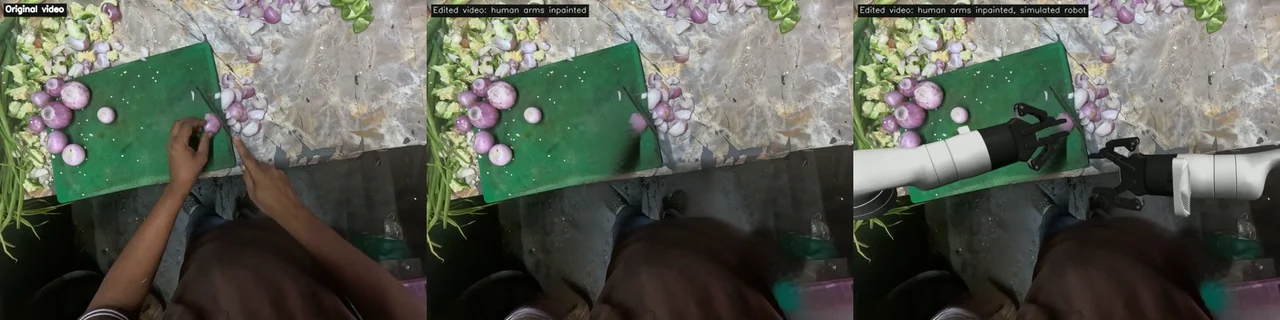
Eight seconds of a shallot being sliced, from camera to simulated robot hand.
FV-B01774 · 486.0–494.0 sthread clip, renders
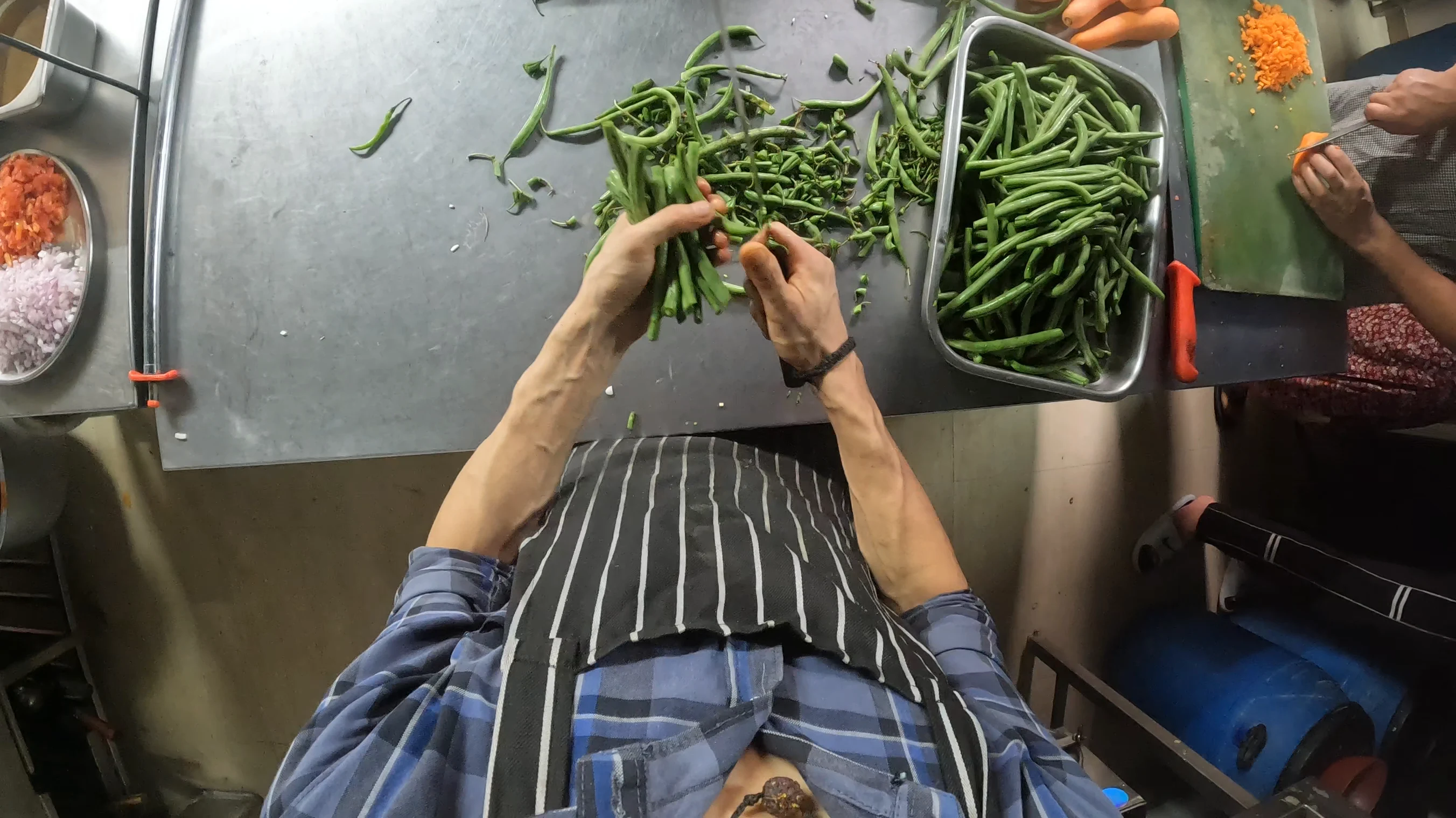
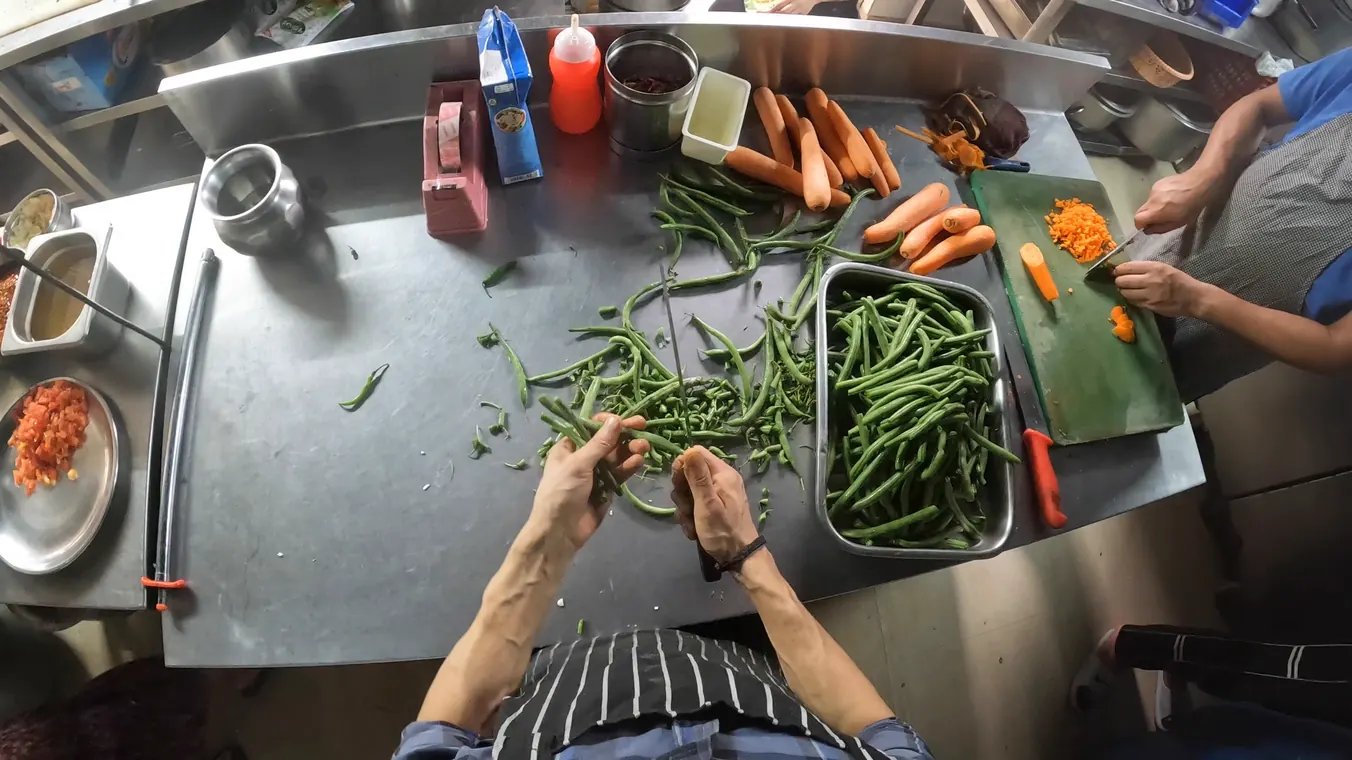
One clip, task 10.1.01, Vegetable washing and chopping. Other clips appear only to show one fact each.
Its camera frames appear inside renders, each labelled as a render.
- Real footage (dark panel)
- Render or edited footage (solid outline, labelled)
One frame, every layer.
Drag the playhead: footage, keypoints, robot hands and edits stay on frame k.
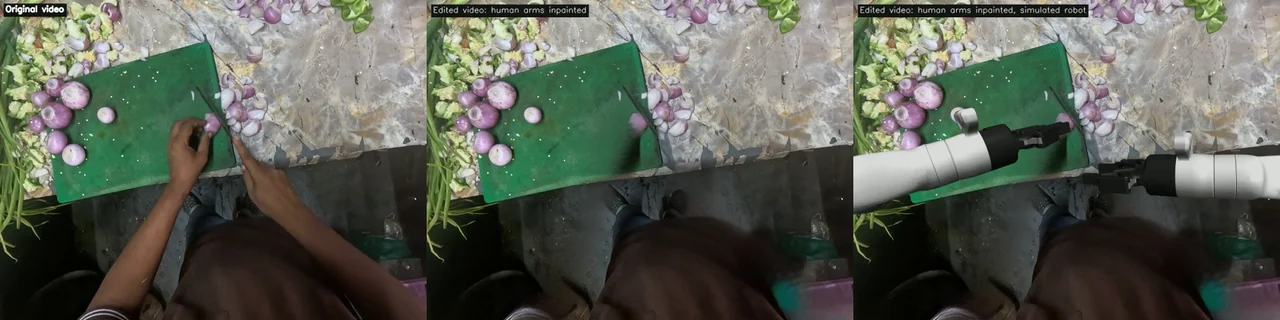
Render of our pipeline output. Left: camera frames (re-encoded). Right: simulated robot hands, not camera footage.
Edited footage: the arms are painted out by a model and a simulated robot is drawn in. Not robot footage.
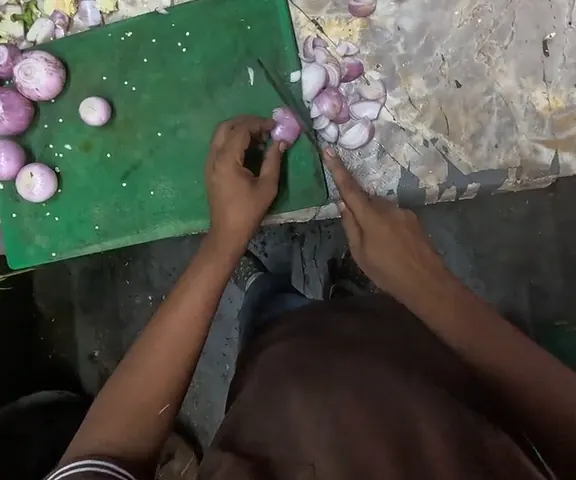
Camera frame (re-encoded)
Hand keypoints (estimated) left right
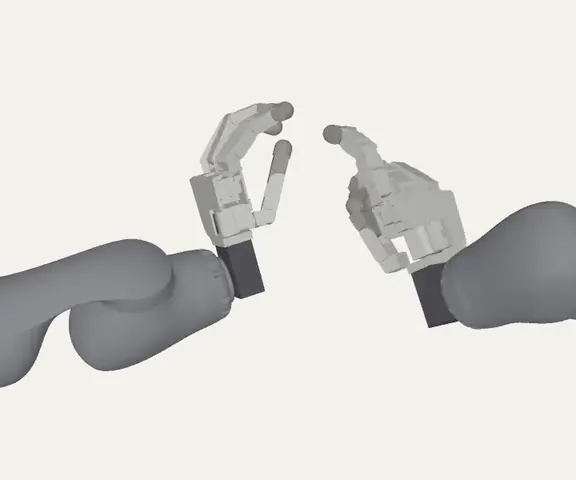
Allegro Hand (sim)
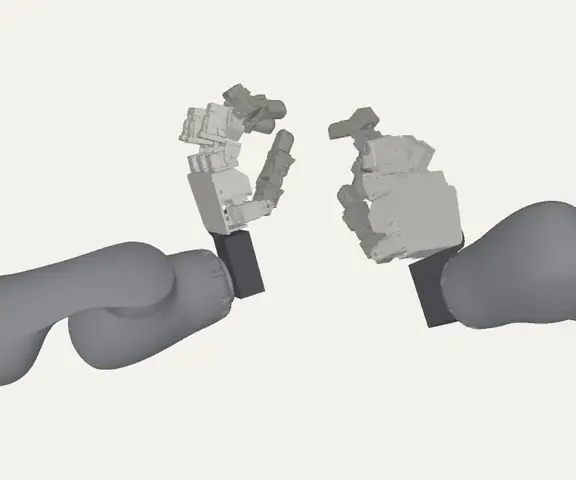
LEAP Hand (sim)
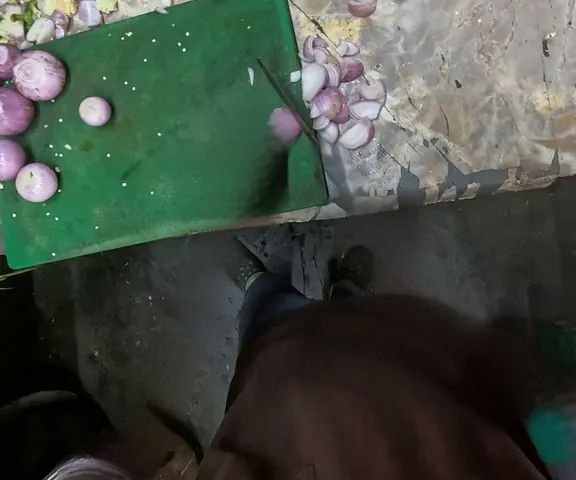
Arms painted out (edited)
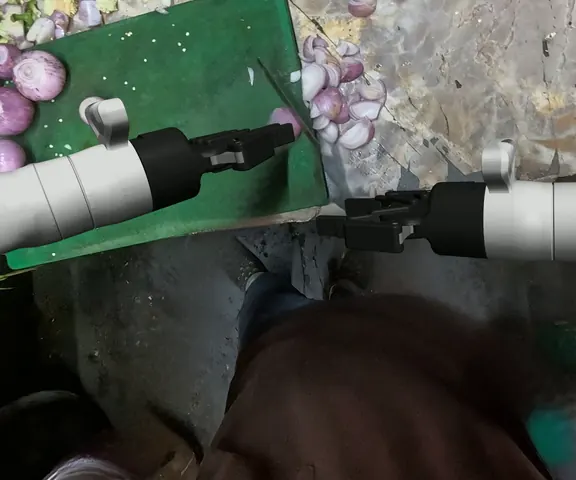
Robot drawn in (edited)
Is every panel on its own frame?
The render's camera panel at loop frame k, compared with the camera frames k−3 to k+3, matches its own frame best. This checks frame indexing only, not how well the hand estimate is timed.
| k−3 | k−2 | k−1 | k | k+1 | k+2 | k+3 |
|---|---|---|---|---|---|---|
| 20.9 | 22.2 | 24.8 | 36.2 | 26.1 | 24.3 | 23.2 |
Highest at k; its own frame scores highest in 210 of 210 frames. Luma PSNR, dB, of the camera panel against the camera frame each offset maps to, measured on the render's compressed web file. Our check on the master file gives 49.10 dB at k 0, 48.75 dB at k 120, 45.16 dB at k 239, against its 35 dB limit.
FV-B01774, loop frames 0–209: 486.0 to 493.0 s of the camera file. The loop shows every second camera frame at 30 fps, so it runs 0.1% fast: 7.000 s shown for 7.007 s filmed.
01Capture
At eye level.
A head camera sees the hands about where a humanoid's head camera would.
FV-Z00907 · at 50.0 sanother clip, frame: Wide lens
FV-B01248 · at 140.0 sanother clip, frame: SuperView lens
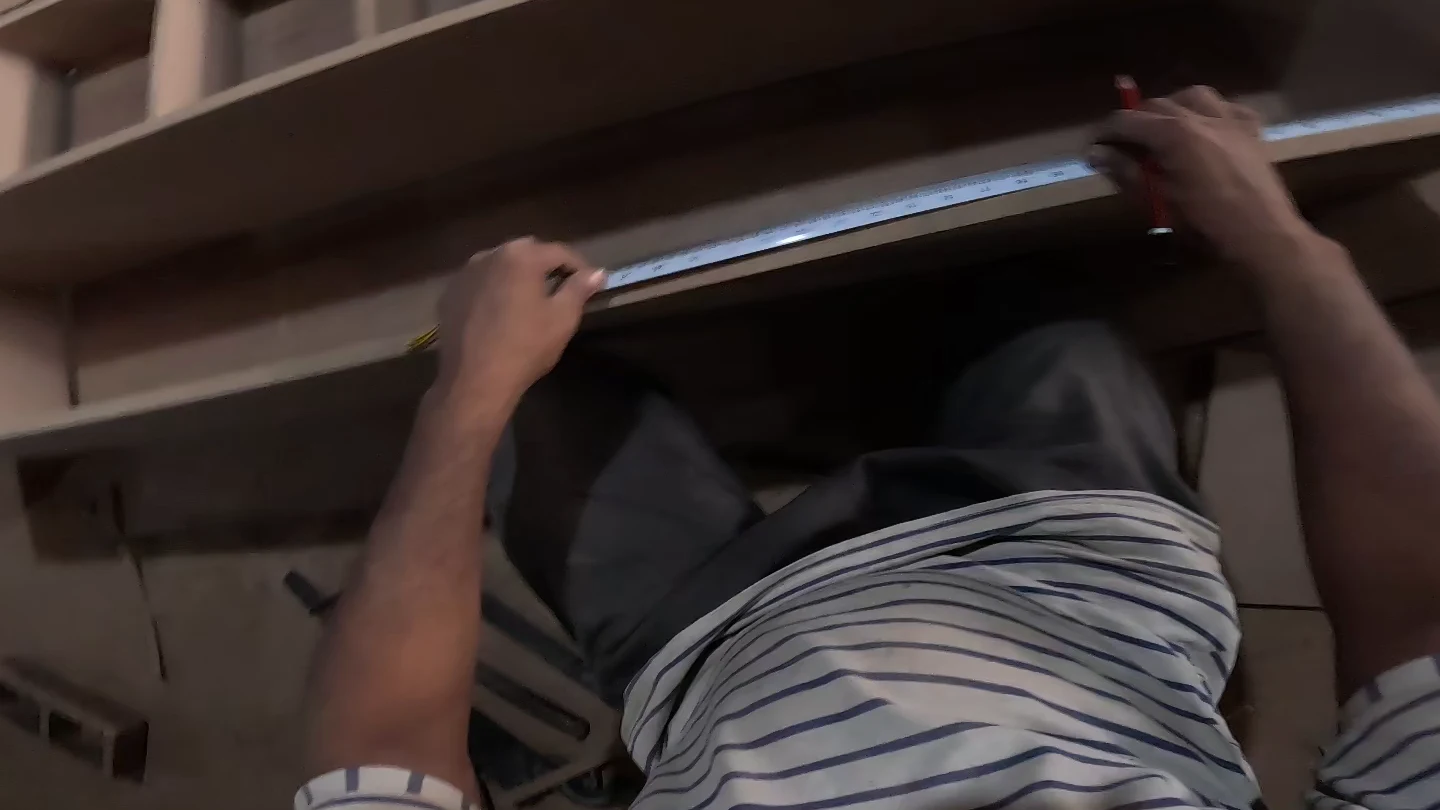
Rings every 10° off the optical axis, drawn by each lens model.
HERO10 Black, Wide: provisional calibration (Kalibr, equidistant), this body and mode.
HERO12 Black, SuperView: the camera's own lens model, read from the file (nominal for the mode).
Every number 3
- On the FV-Z00907 frame (HERO10 Black, Wide), the focal length our pipeline assumes is 8% higher than the lens model gives at the centre; read as a pinhole, depths there come out 8% too far. Field of view: 133.7°, the calibrated model's diagonal field of view.Source: this site's lens data (computed at build from the provisional calibration of this body and mode)
- On the FV-B01248 frame (HERO12 Black, SuperView, cropped as the still is published), our pipeline's focal length is 21% to 24% high at the centre, so pinhole depths come out 23% too far there. Field of view: 148.0°, the file's own diagonal field of view.Source: this site's lens data (computed at build from the lens model the camera writes into the file)
- FV-B01774 was filmed in the Linear lens mode; most of our footage uses Wide or SuperView.Source: the camera file's own settings, read by our pipeline
02One clock
Every head turn, on the clock.
The camera's own IMU, fitted to the video clock, sample by sample.
FV-B01774 · 486.0–494.0 sthread clip, data
Head speed · camera gyro |ω|
The thread clip: p95 45.5 deg/s, median 13.2, peak 72.5, from 1613 samples.
| Clip | Workplace | Stabilisation | p95 (deg/s) | Share at or above |
|---|---|---|---|---|
| FV-B01774 @ 486.0 s (the thread) | Restaurant and Commercial Kitchen | on | 45.5 | 5% |
| FV-B00860 @ 97.1 s | Trade Service — Plumbing, HVAC and Electrical | on | 2.7 | 0% |
| FV-B01827 @ 544.8 s | Carpentry and Furniture Workshop | off | 5.2 | 0% |
| FV-B01690 @ 188.6 s | Carpentry and Furniture Workshop | off | 6.0 | 0% |
| FV-C01812 @ 247.6 s | Metal Fabrication and Welding | off | 7.6 | 0% |
| FV-C01720 @ 676.5 s | Trade Service — Plumbing, HVAC and Electrical | off | 7.9 | 0% |
| FV-B00838 @ 393.4 s | Trade Service — Plumbing, HVAC and Electrical | on | 8.7 | 0% |
| FV-C00012 @ 616.5 s | Retail Store — Back of House | off | 8.8 | 0% |
| FV-B01132 @ 3026.3 s | Carpentry and Furniture Workshop | off | 8.8 | 0% |
| FV-B00385 @ 1353.5 s | Metal Fabrication and Welding | on | 8.9 | 0% |
| FV-B01743 @ 326.1 s | Metal Fabrication and Welding | off | 9.3 | 0% |
| FV-C01534 @ 107.7 s | Carpentry and Furniture Workshop | off | 9.4 | 0% |
| FV-C01768 @ 223.8 s | Metal Fabrication and Welding | off | 9.8 | 0% |
| FV-B01319 @ 559.6 s | Metal Fabrication and Welding | off | 10.5 | 0% |
| FV-C00742 @ 372.8 s | Metal Fabrication and Welding | on | 10.5 | 0% |
| FV-B01248 @ 96.3 s | Carpentry and Furniture Workshop | off | 10.6 | 0% |
| FV-C01442 @ 171.8 s | Carpentry and Furniture Workshop | off | 10.8 | 0% |
| FV-B01150 @ 153.5 s | Restaurant and Commercial Kitchen | off | 10.9 | 0% |
| GX010445 @ 1135.0 s | Carpentry and Furniture Workshop | off | 11.4 | 0% |
| FV-C00905 @ 357.9 s | Restaurant and Commercial Kitchen | off | 11.7 | 1% |
| FV-B01919 @ 416.7 s | Metal Fabrication and Welding | off | 12.4 | 0% |
| FV-C01818 @ 193.8 s | Metal Fabrication and Welding | off | 12.6 | 0% |
| FV-C00689 @ 823.4 s | Trade Service — Plumbing, HVAC and Electrical | on | 13.3 | 0% |
| FV-C00684 @ 575.6 s | Trade Service — Plumbing, HVAC and Electrical | on | 14.4 | 0% |
| FV-C01321 @ 285.7 s | Carpentry and Furniture Workshop | off | 14.4 | 0% |
| FV-B00419 @ 539.5 s | Metal Fabrication and Welding | on | 15.2 | 0% |
| FV-B00476 @ 80.1 s | Metal Fabrication and Welding | on | 15.2 | 0% |
| FV-C01418 @ 1591.5 s | Carpentry and Furniture Workshop | off | 15.3 | 0% |
| FV-B01174 @ 62.7 s | Trade Service — Plumbing, HVAC and Electrical | on | 18.0 | 0% |
| FV-B01155 @ 859.5 s | Restaurant and Commercial Kitchen | off | 18.0 | 0% |
| GX010005 @ 879.1 s | Carpentry and Furniture Workshop | off | 18.2 | 0% |
| GX010125 @ 173.4 s | Carpentry and Furniture Workshop | off | 18.2 | 0% |
| GX010445 @ 461.8 s | Carpentry and Furniture Workshop | off | 18.2 | 0% |
| FV-C01726 @ 381.4 s | Trade Service — Plumbing, HVAC and Electrical | off | 18.7 | 0% |
| FV-B01150 @ 165.2 s | Restaurant and Commercial Kitchen | off | 19.0 | 0% |
| FV-B01794 @ 1431.7 s | Carpentry and Furniture Workshop | off | 19.5 | 0% |
| FV-B01810 @ 386.5 s | Carpentry and Furniture Workshop | off | 20.4 | 0% |
| FV-C01132 @ 618.1 s | Restaurant and Commercial Kitchen | off | 20.4 | 0% |
| FV-B01174 @ 89.1 s | Trade Service — Plumbing, HVAC and Electrical | on | 21.0 | 1% |
| FV-B01822 @ 105.0 s | Carpentry and Furniture Workshop | off | 22.1 | 0% |
| FV-C00744 @ 8.3 s | Metal Fabrication and Welding | on | 22.3 | 0% |
| FV-B00838 @ 263.3 s | Trade Service — Plumbing, HVAC and Electrical | on | 26.5 | 0% |
| FV-C01419 @ 199.7 s | Carpentry and Furniture Workshop | off | 26.7 | 0% |
| GX011161 @ 741.2 s | Carpentry and Furniture Workshop | off | 26.8 | 0% |
| FV-C00024 @ 127.9 s | Retail Store — Back of House | off | 28.8 | 0% |
| FV-B01835 @ 390.0 s | Carpentry and Furniture Workshop | off | 28.9 | 0% |
| FV-B01149 @ 958.1 s | Restaurant and Commercial Kitchen | off | 29.1 | 0% |
| FV-B01851 @ 493.3 s | Carpentry and Furniture Workshop | off | 29.6 | 1% |
| FV-B01155 @ 820.0 s | Restaurant and Commercial Kitchen | off | 29.6 | 2% |
| FV-C00745 @ 235.0 s | Metal Fabrication and Welding | on | 29.8 | 2% |
| GX010007 @ 699.6 s | Carpentry and Furniture Workshop | off | 29.9 | 2% |
| FV-B01851 @ 492.0 s | Carpentry and Furniture Workshop | off | 30.2 | 1% |
| FV-B00704 @ 335.7 s | Metal Fabrication and Welding | off | 30.2 | 0% |
| FV-B01174 @ 101.1 s | Trade Service — Plumbing, HVAC and Electrical | on | 31.6 | 3% |
| FV-B01857 @ 670.0 s | Carpentry and Furniture Workshop | off | 34.2 | 1% |
| FV-B00704 @ 493.2 s | Metal Fabrication and Welding | off | 34.4 | 2% |
| FV-B01264 @ 2316.1 s | Carpentry and Furniture Workshop | off | 34.9 | 0% |
| FV-B01810 @ 222.0 s | Carpentry and Furniture Workshop | off | 35.2 | 1% |
| FV-B01155 @ 860.9 s | Restaurant and Commercial Kitchen | off | 36.2 | 2% |
| FV-B00476 @ 20.0 s | Metal Fabrication and Welding | on | 36.7 | 1% |
| FV-C01283 @ 1140.4 s | Restaurant and Commercial Kitchen | off | 37.2 | 1% |
| FV-B01827 @ 327.3 s | Carpentry and Furniture Workshop | off | 37.5 | 1% |
| FV-B01319 @ 649.0 s | Metal Fabrication and Welding | off | 37.6 | 0% |
| GX010445 @ 663.0 s | Carpentry and Furniture Workshop | off | 38.2 | 2% |
| FV-B01690 @ 589.0 s | Carpentry and Furniture Workshop | off | 39.3 | 3% |
| FV-C01638 @ 892.0 s | Carpentry and Furniture Workshop | off | 40.1 | 1% |
| FV-B00361 @ 155.4 s | Retail Store — Back of House | off | 42.3 | 3% |
| FV-B01857 @ 636.0 s | Carpentry and Furniture Workshop | off | 43.7 | 5% |
| FV-B00175 @ 9.0 s | Retail Store — Back of House | on | 44.3 | 4% |
| FV-B01155 @ 868.9 s | Restaurant and Commercial Kitchen | off | 45.3 | 5% |
| FV-B01827 @ 561.3 s | Carpentry and Furniture Workshop | off | 46.0 | 5% |
| FV-C01738 @ 1034.9 s | Restaurant and Commercial Kitchen | off | 48.3 | 6% |
| FV-B01851 @ 493.8 s | Carpentry and Furniture Workshop | off | 49.0 | 5% |
| FV-C00023 @ 190.4 s | Retail Store — Back of House | off | 49.7 | 8% |
| FV-Z00907 @ 20.0 s | Restaurant and Commercial Kitchen | off | 54.2 | 7% |
| FV-C01077 @ 142.7 s | Trade Service — Plumbing, HVAC and Electrical | on | 55.1 | 7% |
| FV-B01827 @ 323.4 s | Carpentry and Furniture Workshop | off | 58.5 | 15% |
| FV-B01149 @ 961.0 s | Restaurant and Commercial Kitchen | off | 64.9 | 9% |
| FV-B01150 @ 216.2 s | Restaurant and Commercial Kitchen | off | 72.8 | 11% |
| FV-B00175 @ 118.3 s | Retail Store — Back of House | on | 75.9 | 15% |
| FV-B00836 @ 744.7 s | Trade Service — Plumbing, HVAC and Electrical | on | 78.1 | 35% |
| FV-B01149 @ 1011.0 s | Restaurant and Commercial Kitchen | off | 90.7 | 18% |
| This site's own clips | ||||
| FV-B00325 @ 270.0 s | — | — | 24.7 | 0% |
| FV-B00023 @ 122.0 s | — | — | 37.7 | 2% |
| FV-Z00908 @ 408.0 s | — | — | 73.1 | 13% |
| FV-Z00906 @ 32.0 s | — | — | 92.2 | 25% |
| FV-Z00901 @ 246.5 s | — | — | 138.2 | 35% |
| FV-C00456 @ 16.0 s | — | — | 216.9 | 16% |
FV-B01857 · 300.0–310.0 sanother clip, data: frames and samples on one axis
video frame · every 20,000 µs (50 fps)IMU sample · mean spacing 5,002 µs (200 Hz measured)1 ms tick
t = ––––––––––– µs · frame –––––– from ––––––––––– µs · nearest IMU sample ––––– of 1,999 at ––––––––––– µs (frame start ––––––– µs)
FV-B01827 · 323.4–331.4 sanother clip, footage: stabilisation off
Every number 8
- IMU written at a nominal 200 Hz.Source: GoPro's published GPMF format: the camera writes its IMU at a nominal 200 Hz
- Measured at 196.2 to 201.1 Hz on every clip with IMU on this site.Source: clips.json (each clip's IMU sidecar)
- FV-B01774, 486.0–494.0 s: head speed median 13.2 deg/s, 95th percentile 45.5, peak 72.5, from 1,613 gyro samples. Stabilisation on.Source: the head‑motion data (computed at build from the camera's GPMF gyro track, extracted by our pipeline)
- Fastest whole second: 491–492 s, 95th percentile 68.4 deg/s, peak 72.5, while the hands keep working.Source: the same samples, computed at build from them
- Gyro 95th percentile from 2.7 to 90.7 deg/s across 81 clips our scouts picked for visible hands; not a library‑wide distribution.Source: the head‑motion data (computed at build from each clip's camera file)
- FV-B01827 was filmed with stabilisation off.Source: its pose sidecar (the camera's own settings box, read from the file)
- Down for the camera body: 10.8° from straight down, against 73.9° guessed from the hands.Source: our audit of the gravity worked example on this clip (axis convention not checked)
- In the delivered _imu.csv the sensor clock is fitted to the video timeline over the whole file, so timestamps are smooth, not quantised to the container's 1 ms timescale.Source: our IMU extraction, as it writes every delivered _imu.csv
03The wearer's hands
Two hands. No filler.
Only the wearer's hands. A frame without an estimate is listed, never filled.
FV-B01774 · 486.0–494.0 sthread clip, render
Render of our pipeline output: estimated hand keypoints drawn over camera frames (re-encoded). An estimate, not a measurement.

Not camera footage.
Notes (1)
FV-Z00907 · 20.0–28.0 sanother clip, render: whose hands, and a hand that leaves the frame
How each hand was judged
- Wearer's left hand. The ray from the knuckles through the wrist meets the bottom edge at 0.33 of the width: inside 0.20 to 0.95, where the wearer's forearms enter. Kept.
- Wearer's right hand. The ray from the knuckles through the wrist meets the bottom edge at 0.59 of the width: inside 0.20 to 0.95, where the wearer's forearms enter. Kept.
- A co-worker's hand. The ray from the knuckles through the wrist leaves through the right edge at 0.45 of the height: a wearer's forearm leaves the right edge only from 0.80 of the height down. Rejected. Its box also sits in a zone marked by hand for this clip's co-worker.
- A co-worker's hand. The ray from the knuckles through the wrist leaves through the right edge at 0.18 of the height: a wearer's forearm leaves the right edge only from 0.80 of the height down. Rejected. Its box also sits in a zone marked by hand for this clip's co-worker.
Render of our pipeline output: estimated hand keypoints drawn over camera frames (re-encoded). An estimate, not a measurement.

Not camera footage.
Notes (2)
FV-Z00907, right hand: an estimate on 186 of 240 frames. The others (frames 184–237) are listed with the reason, never filled.
- Estimate · 183 a 3D estimate of the right hand on this frame.
- Estimate, low confidence · 3 an estimate our pipeline marks low confidence.
- No estimate: fit disagreed · 6 the 3D fit disagreed with the 2D landmarks by more than the gate allows, so it was dropped.
- No estimate: isolated · 1 a lone detection with no right-hand detection within two frames, so it was dropped.
- No estimate: tracker box · 1 a box carried over by the visual tracker that the fitted hand covered poorly, so it was dropped.
- No estimate: not detected · 46 no right-hand detection on this frame to fit.
| Second | Frame +0 | Frame +1 | Frame +2 | Frame +3 | Frame +4 | Frame +5 | Frame +6 | Frame +7 | Frame +8 | Frame +9 | Frame +10 | Frame +11 | Frame +12 | Frame +13 | Frame +14 | Frame +15 | Frame +16 | Frame +17 | Frame +18 | Frame +19 | Frame +20 | Frame +21 | Frame +22 | Frame +23 | Frame +24 | Frame +25 | Frame +26 | Frame +27 | Frame +28 | Frame +29 |
|---|---|---|---|---|---|---|---|---|---|---|---|---|---|---|---|---|---|---|---|---|---|---|---|---|---|---|---|---|---|---|
| 0 s | Estimate | Estimate | Estimate | Estimate | Estimate | Estimate | Estimate | Estimate | Estimate | Estimate | Estimate | Estimate | Estimate | Estimate | Estimate | Estimate | Estimate | Estimate | Estimate | Estimate | Estimate | Estimate | Estimate | Estimate | Estimate | Estimate | Estimate | Estimate | Estimate | Estimate |
| 1 s | Estimate | Estimate | Estimate | Estimate | Estimate | Estimate | Estimate | Estimate | Estimate | Estimate | Estimate | Estimate | Estimate | Estimate | Estimate | Estimate | Estimate | Estimate | Estimate | Estimate | Estimate | Estimate | Estimate | Estimate | Estimate | Estimate | Estimate | Estimate | Estimate | Estimate |
| 2 s | Estimate | Estimate | Estimate | Estimate | Estimate | Estimate | Estimate | Estimate | Estimate | Estimate | Estimate | Estimate | Estimate | Estimate | Estimate | Estimate | Estimate | Estimate | Estimate | Estimate | Estimate | Estimate | Estimate | Estimate | Estimate | Estimate | Estimate | Estimate | Estimate | Estimate |
| 3 s | Estimate | Estimate | Estimate | Estimate | Estimate | Estimate | Estimate | Estimate | Estimate | Estimate | Estimate | Estimate | Estimate | Estimate | Estimate | Estimate | Estimate | Estimate | Estimate | Estimate | Estimate | Estimate | Estimate | Estimate | Estimate | Estimate | Estimate | Estimate | Estimate | Estimate |
| 4 s | Estimate, low confidence | Estimate | Estimate | Estimate | Estimate | Estimate | Estimate | Estimate | Estimate | Estimate | Estimate | Estimate | Estimate | Estimate | Estimate | Estimate | Estimate | Estimate | Estimate | Estimate | Estimate | Estimate | Estimate | Estimate | Estimate | Estimate | Estimate | Estimate | Estimate | Estimate |
| 5 s | Estimate | Estimate | Estimate | Estimate | Estimate | Estimate | Estimate | Estimate | Estimate | Estimate, low confidence | Estimate | Estimate | Estimate | Estimate | Estimate | Estimate | Estimate | Estimate | Estimate | Estimate | Estimate | Estimate | Estimate | Estimate | Estimate | Estimate | Estimate | Estimate | Estimate | Estimate |
| 6 s | Estimate | Estimate | Estimate | Estimate, low confidence | No estimate: fit disagreed | No estimate: not detected | No estimate: fit disagreed | No estimate: fit disagreed | No estimate: fit disagreed | No estimate: fit disagreed | No estimate: not detected | No estimate: not detected | No estimate: not detected | No estimate: not detected | No estimate: not detected | No estimate: not detected | No estimate: not detected | No estimate: not detected | No estimate: not detected | No estimate: not detected | No estimate: not detected | No estimate: not detected | No estimate: not detected | No estimate: not detected | No estimate: not detected | No estimate: not detected | No estimate: not detected | No estimate: not detected | No estimate: not detected | No estimate: not detected |
| 7 s | No estimate: not detected | No estimate: not detected | No estimate: not detected | No estimate: not detected | No estimate: not detected | No estimate: not detected | No estimate: not detected | No estimate: not detected | No estimate: not detected | No estimate: not detected | No estimate: not detected | No estimate: not detected | No estimate: not detected | No estimate: not detected | No estimate: not detected | No estimate: isolated | No estimate: not detected | No estimate: not detected | No estimate: not detected | No estimate: not detected | No estimate: not detected | No estimate: not detected | No estimate: not detected | No estimate: fit disagreed | No estimate: not detected | No estimate: not detected | No estimate: not detected | No estimate: tracker box | Estimate | Estimate |
Point at a frame, or tab into the strip and use the arrow keys, to read its state.
Every number 5
- FV-B01774: left hand estimated in 240 of 240 frames, right hand in 240 of 240.Source: the layer scrubber's keypoint data (computed at build from our HaMeR estimates)
- Our MediaPipe route found 34.5% of visible wearer hands on 120 random labelled frames.Source: our own check: 120 random labelled frames, wearer hands counted by hand
- FV-Z00907: no right‑hand estimate in 54 of 240 frames.Source: our per‑frame hand tracks for FV-Z00907 (frames k 184–237)
- FV-Z00907, 20.0–28.0 s, right hand, frame by frame: an estimate in 186 of 240 frames (3 of them low confidence), none in 54: 6 fit disagreed, 1 isolated, 1 tracker box, 46 not detected.Source: the frame strip's data (computed at build from our per‑frame hand tracks and their drop reasons)
- FV-Z00907 frame k 140 (24.7 s into the file): MediaPipe found 4 hands and the rule kept 2 as the wearer's. A hand is kept if the ray from its knuckles through its wrist meets the bottom edge between 0.20 and 0.95 of the width, or the right edge at 0.80 of the height or lower. Not scored against labelled frames.Source: the wearer‑reveal data (computed at build from our MediaPipe candidates for that frame; the ray is recomputed and checked against our pipeline's record)
04Labels
Coded, then spelled out.
One code per stretch, from 354 tasks; on request, words from goal to step.
FV-Z00906 · 160.0–168.0 sanother clip, footage: labels from goal to step
1 session goal, 4 sub-goals, 21 episodes, 237 steps in 711.7 sauto-labelled · first-pass
Session goal Iron, fold, and stack shirts, jackets, shorts, and trousers on the ironing table.
Sub-goal 1 Iron, button, and smooth shirts on the ironing board. holds the 8 s loop
Episode 1 Iron and button the shirt on the ironing board.
- Both hands: reposition shirt on ironing board0.0–1.8 s
- Right hand: pick up iron from standLeft hand: hold shirt1.8–3.2 s
- Right hand: iron shirt with ironLeft hand: hold shirt3.2–12.0 s
- Right hand: iron shirt with ironLeft hand: hold shirt12.0–16.5 s
- Right hand: place iron on standLeft hand: reposition shirt16.5–18.0 s
- Both hands: reposition shirt on ironing board18.0–20.0 s
- Both hands: button shirt20.0–23.5 s
- Both hands: button shirt23.5–27.0 s
- Both hands: button shirt27.0–30.0 s
Episode 2 Smooth, iron, and fold the navy shirt.
- Both hands: unfold navy shirt30.0–33.0 s
- Both hands: align navy shirt on ironing table33.0–37.0 s
- Both hands: smooth navy shirt on ironing table37.0–42.0 s
- Right hand: pick up iron42.0–44.0 s
- Left hand: hold navy shirtRight hand: iron navy shirt with iron44.0–51.0 s
- Right hand: place iron on stand51.0–52.0 s
- Both hands: fold navy shirt on ironing table52.0–56.0 s
- Both hands: smooth navy shirt on ironing table56.0–60.0 s
- Left hand: hold shirt on ironing boardRight hand: iron shirt with iron60.0–66.0 s
- Right hand: place iron on stand66.0–67.5 s
- Both hands: fold sleeve of shirt67.5–71.0 s
- Both hands: pick up shirtBoth hands: place shirt on ironing board71.0–73.0 s
- Both hands: flatten shirt on ironing board73.0–78.0 s
- Both hands: fold side of shirt78.0–82.0 s
- Both hands: fold shirt82.0–85.0 s
- Both hands: fold shirt85.0–88.0 s
Episode 3 Check phone, retrieve garment, and iron it on the board.
- observe workspace88.0–90.0 s
- Right hand: use phone90.0–95.0 s
- walk to chair95.0–98.0 s
- Right hand: pick up garment from chair98.0–100.5 s
- Both hands: place garment on ironing board100.5–103.0 s
- Both hands: unfold garment on ironing board103.0–106.5 s
- Both hands: reposition garment on ironing board106.5–110.0 s
- Both hands: flatten garment on ironing board110.0–112.0 s
- Right hand: pick up iron from stand112.0–113.2 s
- Left hand: hold garment on ironing boardRight hand: iron garment with iron113.2–116.0 s
- Right hand: place iron on stand116.0–117.0 s
- Both hands: pick up phone from ironing board117.0–118.5 s
- Both hands: use phone118.5–120.0 s
- Right hand: hold phone120.0–122.0 s
- Right hand: place phone on table122.0–123.0 s
Episode 4 Smooth, flip, and iron the brown shirt.
- Both hands: unfold brown shirt on table123.0–126.0 s
- Both hands: smooth brown shirt on table126.0–131.0 s
- Right hand: pick up ironLeft hand: stabilize brown shirt131.0–132.0 s
- Right hand: iron brown shirt with ironLeft hand: hold brown shirt132.0–135.0 s
- Right hand: place iron on stand135.0–136.0 s
- Both hands: flip brown shirt on table136.0–139.0 s
- Both hands: smooth brown shirt on table139.0–143.0 s
- Right hand: iron brown shirt with ironLeft hand: hold brown shirt143.0–147.0 s
- Right hand: place iron on stand147.0–148.0 s
- Both hands: flip brown shirt on table148.0–150.0 s
Episode 5 Smooth, fasten buttons, and iron the polo shirt. holds the 8 s loop
- Both hands: spread polo shirt on ironing board150.0–152.5 s
- Both hands: smooth polo shirt on ironing board152.5–156.5 s
- Right hand: pick up iron from stand168.5–170.0 s
- Right hand: iron polo shirt with ironLeft hand: hold polo shirt170.0–178.5 s
- Both hands: reposition polo shirt on ironing board178.5–180.0 s
- Both hands: smooth shirt on table180.0–182.8 s
- Left hand: hold shirtRight hand: iron shirt with iron182.8–189.0 s
- Right hand: place iron on stand189.0–190.3 s
- Both hands: reposition shirt on table190.3–194.5 s
- Both hands: turn shirt over on table194.5–197.2 s
- Both hands: smooth shirt on table197.2–201.6 s
- Right hand: pick up iron from standLeft hand: hold shirt201.6–203.0 s
- Left hand: hold shirtRight hand: iron shirt with iron203.0–207.5 s
- Right hand: place iron on stand207.5–208.8 s
- Both hands: smooth shirt on table208.8–210.0 s
- Both hands: smooth shirt on ironing board210.0–211.0 s
- Right hand: iron shirt with ironLeft hand: hold shirt211.0–215.0 s
- Right hand: place iron on stand215.0–216.0 s
Sub-goal 2 Iron, fold, and stack shirts, a jacket, and pants.
Episode 6 Fold the shirt and place it on the stack.
- Both hands: fold side of shirt216.0–220.0 s
- Both hands: fold other side of shirt220.0–224.0 s
- Both hands: smooth shirt224.0–227.0 s
- Both hands: align shirt on ironing board227.0–231.0 s
- Both hands: fold bottom of shirt upward231.0–236.0 s
- Both hands: turn shirt overBoth hands: adjust collar236.0–240.0 s
- Both hands: place folded shirt on stack240.0–242.0 s
Episode 7 Retrieve, smooth, and fold the t‑shirt onto the stack.
- turn to chairRight hand: pick up t‑shirt from chair242.0–245.0 s
- Both hands: unfold t‑shirt245.0–248.0 s
- Both hands: align shoulders of t‑shirt248.0–251.0 s
- Both hands: spread t‑shirt on table251.0–254.0 s
- Both hands: smooth t‑shirt on table254.0–258.0 s
- Both hands: fold side of t‑shirt258.0–262.0 s
- Both hands: fold side of t‑shirt262.0–266.0 s
- Both hands: fold t‑shirt in half266.0–268.0 s
- Both hands: smooth folded t‑shirt268.0–270.0 s
- Both hands: place folded shirt on stack of clothes270.0–273.0 s
Episode 8 Zip, smooth, and fold the black jacket onto the stack.
- walk to chair273.0–275.0 s
- Right hand: sort through clothes on chair275.0–278.0 s
- Both hands: sort through clothes on chair278.0–283.0 s
- Both hands: pick up black shirt from chair283.0–286.0 s
- Both hands: hold black shirtwalk to ironing board286.0–288.0 s
- Both hands: spread black shirt on ironing board288.0–293.0 s
- Both hands: turn sleeve of black shirt right side out293.0–297.0 s
- Both hands: reposition black shirt on ironing board297.0–300.0 s
- Both hands: place black jacket on table300.0–302.0 s
- Both hands: zip up black jacket302.0–308.0 s
- Both hands: smooth black jacket on table308.0–311.0 s
- Both hands: lift black jacket311.0–313.0 s
- Both hands: place black jacket on table313.0–315.0 s
- Both hands: smooth black jacket on table315.0–318.0 s
- Right hand: smooth black jacket on tableLeft hand: hold black jacket318.0–321.0 s
- Both hands: smooth black jacket on table321.0–326.0 s
- Right hand: fold sleeve of black jacketLeft hand: hold black jacket326.0–330.0 s
- Both hands: fold black garment330.0–333.0 s
- Both hands: fold black garment333.0–336.0 s
- Both hands: fold black garment336.0–338.0 s
- Both hands: fold black garment338.0–342.0 s
- Both hands: pick up folded black garmentBoth hands: place folded black garment on stack342.0–345.0 s
Episode 9 Smooth, iron, and fold the white undershirt onto the stack.
- turn toward chairRight hand: pick up white undershirt from pile345.0–348.0 s
- Both hands: unfold white undershirt348.0–350.0 s
- Both hands: place white undershirt on table350.0–353.0 s
- Both hands: inspect white undershirt353.0–357.0 s
- Both hands: spread white undershirt on table357.0–360.0 s
- Both hands: unfold undershirt360.0–362.5 s
- Both hands: align undershirt on ironing board362.5–364.5 s
- Both hands: smooth undershirt on ironing board364.5–368.5 s
- Both hands: align straps of undershirt368.5–371.0 s
- Both hands: smooth undershirt on ironing board371.0–373.0 s
- Right hand: pick up ironLeft hand: hold undershirt373.0–374.5 s
- Right hand: iron undershirt with ironLeft hand: hold undershirt374.5–381.5 s
- Right hand: place iron on standLeft hand: hold undershirt381.5–383.0 s
- Both hands: fold undershirt383.0–385.0 s
- Both hands: lift and flip undershirt385.0–387.5 s
- Both hands: smooth undershirt on ironing board387.5–389.0 s
- Right hand: pick up ironLeft hand: hold undershirt389.0–390.0 s
- Right hand: iron undershirt with ironLeft hand: hold undershirt390.0–399.0 s
- Right hand: place iron on standLeft hand: hold undershirt399.0–400.5 s
- Both hands: fold undershirt400.5–404.0 s
- Both hands: fold undershirt404.0–407.0 s
- Both hands: place folded undershirt on clothes stack407.0–409.0 s
Episode 10 Smooth, iron, and fold the pants onto the pile.
- walk to chairRight hand: pick up pants from chair409.0–412.0 s
- Both hands: unfold pants412.0–414.5 s
- Both hands: spread pants on ironing table414.5–417.5 s
- Both hands: smooth pants on ironing table417.5–420.0 s
- Both hands: smooth pants on ironing board420.0–421.0 s
- Left hand: hold pantsRight hand: iron pants with iron421.0–426.0 s
- Left hand: hold pantsRight hand: iron pants with iron426.0–431.0 s
- Right hand: place iron on iron restLeft hand: hold pants431.0–432.0 s
- Both hands: fold pants on ironing board432.0–436.0 s
- Both hands: smooth pants on ironing board436.0–440.0 s
- Left hand: hold pantsRight hand: pick up iron440.0–441.0 s
- Left hand: hold pantsRight hand: iron pants with iron441.0–446.0 s
- Left hand: hold pantsRight hand: iron pants with iron446.0–450.0 s
- Right hand: place iron on stand450.0–451.0 s
- Both hands: fold pants451.0–455.0 s
- Both hands: smooth pants on table455.0–457.0 s
- Both hands: fold pants457.0–460.0 s
- Both hands: place folded pants onto pile on table460.0–461.0 s
- walk to chair461.0–463.0 s
Sub-goal 3 Iron, flip, and fold plaid shorts on the table.
Episode 11 Pick up, unfold, align, and iron plaid shorts on the table.
- Right hand: pick up plaid shorts from chair463.0–466.0 s
- Both hands: unfold plaid shorts466.0–468.0 s
- Both hands: align plaid shorts on table468.0–471.0 s
- Both hands: flip plaid shorts on table471.0–473.0 s
- Left hand: smooth plaid shorts on tableRight hand: pick up iron from stand473.0–474.0 s
- Left hand: hold plaid shorts on tableRight hand: iron plaid shorts with iron474.0–478.0 s
- Right hand: place iron on stand478.0–479.0 s
Episode 12 Spread, flip, smooth, and iron shorts on the table.
- Both hands: fold plaid shorts479.0–480.0 s
- Both hands: spread shorts on table480.0–481.0 s
- Both hands: smooth shorts on table481.0–486.0 s
- Both hands: reposition shorts on table486.0–488.0 s
- Both hands: flip shorts on table488.0–491.0 s
- Both hands: smooth shorts on table491.0–494.0 s
- Right hand: pick up iron from standLeft hand: smooth shorts494.0–495.0 s
- Right hand: iron shorts with ironLeft hand: hold shorts495.0–502.0 s
- Right hand: place iron on stand502.0–503.0 s
Episode 13 Flip, smooth, reposition, and iron shorts on the table.
- Both hands: flip shorts on table503.0–508.0 s
- Both hands: smooth shorts on table508.0–510.0 s
- Both hands: smooth shorts on table510.0–512.0 s
- Left hand: hold shortsRight hand: pick up iron from table512.0–513.5 s
- Left hand: hold shortsRight hand: iron shorts with iron513.5–519.5 s
- Right hand: place iron on table519.5–521.0 s
- Both hands: reposition shorts on table521.0–524.0 s
- Left hand: smooth shortsRight hand: pick up iron from table524.0–525.5 s
- Left hand: hold shortsRight hand: iron shorts with iron525.5–529.0 s
- Right hand: place iron on table529.0–530.5 s
Episode 14 Iron, fold, and place plaid shorts onto the stack of clothes.
- Both hands: fold shorts on table530.5–533.0 s
- Left hand: smooth shortsRight hand: pick up iron from table533.0–534.5 s
- Left hand: hold shortsRight hand: iron shorts with iron534.5–538.0 s
- Right hand: place iron on tableLeft hand: hold shorts538.0–539.0 s
- Right hand: pick up shorts from table539.0–540.0 s
- Both hands: unfold plaid shorts540.0–544.0 s
- Both hands: fold plaid shorts on table544.0–549.5 s
- Both hands: place plaid shorts on stack of clothes549.5–551.0 s
Sub-goal 4 Iron, smooth, and fold pants and trousers on the ironing board.
Episode 15 Pick up, unfold, flatten, and iron pants on the ironing table.
- Both hands: pick up pants from chair551.0–553.5 s
- Both hands: unfold pants553.5–555.0 s
- Both hands: place pants on ironing table555.0–557.0 s
- Both hands: unfold pants557.0–559.0 s
- Both hands: flatten pants on ironing table559.0–560.5 s
- Right hand: pick up ironLeft hand: hold pants560.5–562.0 s
- Right hand: iron pants with ironLeft hand: hold pants562.0–566.0 s
- Right hand: iron pants with ironLeft hand: hold pants566.0–570.0 s
- Left hand: hold pantsRight hand: iron pants with iron570.0–572.0 s
- Right hand: place iron on standLeft hand: hold pants572.0–573.2 s
Episode 16 Pick up, operate, and place phone on the table.
- Right hand: pick up phone from table573.2–574.2 s
- Both hands: operate phone574.2–576.0 s
- Right hand: place phone on table576.0–577.0 s
Episode 17 Reposition and smooth pants on the ironing board and observe workspace.
- Right hand: reposition pants on ironing board577.0–578.2 s
- Both hands: pick up pants from ironing boardBoth hands: place pants on ironing board578.2–580.2 s
- Right hand: smooth pants on ironing board580.2–582.0 s
- Right hand: fold pant legLeft hand: hold pants582.0–584.0 s
- Both hands: smooth pants on ironing board584.0–587.5 s
- observe workspace587.5–594.0 s
- observe workspace594.0–600.0 s
- observe workspace600.0–604.5 s
Episode 18 Flatten, reposition, and iron trouser leg and pants on the table.
- Both hands: flatten trouser leg on ironing table604.5–605.8 s
- Right hand: pick up iron605.8–607.0 s
- Left hand: hold trouser leg on ironing tableRight hand: iron trouser leg with iron607.0–616.0 s
- Left hand: hold trouser leg on ironing tableRight hand: iron trouser leg with iron616.0–621.5 s
- Right hand: place iron on standRight hand: smooth trouser leg621.5–623.0 s
- Both hands: reposition trouser leg on ironing table623.0–627.0 s
- Right hand: pick up iron from standLeft hand: hold trouser leg627.0–628.5 s
- Right hand: iron trouser leg with ironLeft hand: hold trouser leg628.5–630.0 s
- Right hand: iron pants with ironLeft hand: hold pants630.0–636.0 s
- Right hand: iron pants with ironLeft hand: hold pants636.0–641.0 s
- Right hand: place iron on stand641.0–643.0 s
Episode 19 Fold, align, and smooth pants on the ironing board.
- Right hand: fold pants on ironing board643.0–648.0 s
- Right hand: align pants on ironing board648.0–651.0 s
- Right hand: fold pants on ironing board651.0–656.0 s
- Right hand: align pants on ironing board656.0–660.0 s
- Right hand: fold pants on ironing board660.0–663.0 s
- Right hand: smooth pants on ironing boardLeft hand: hold pants663.0–667.0 s
Episode 20 Pick up, operate, and place smartphone on the ironing board.
- Both hands: pick up smartphone667.0–668.0 s
- Both hands: operate smartphone668.0–670.0 s
- Left hand: place smartphone on ironing board670.0–671.0 s
Episode 21 Smooth, fold, and iron trousers on the ironing board.
- Right hand: smooth pants on ironing board671.0–673.0 s
- Both hands: fold pants on ironing board673.0–679.0 s
- Both hands: align pants on ironing board679.0–684.0 s
- Both hands: smooth pants on ironing board684.0–687.0 s
- Right hand: iron pants with ironLeft hand: hold pants687.0–690.0 s
- Left hand: hold trousersRight hand: iron trousers with iron690.0–694.0 s
- Left hand: flatten trousersRight hand: iron trousers with iron694.0–697.0 s
- Right hand: iron trousers with ironLeft hand: hold trousers697.0–700.0 s
- Left hand: hold trousersRight hand: iron trousers with iron700.0–704.0 s
- Right hand: iron trousers with ironLeft hand: hold trousers704.0–709.0 s
- Right hand: place iron on ironing board709.0–710.2 s
- Both hands: fold trousers710.2–711.7 s
Every number 3
- 354 tasks in 70 task groups across 16 workplaces.Source: taxonomy.json (the frozen task list), counted at build
- The thread carries 10.1.01, Vegetable washing and chopping.Source: the audit's clip master (M64)
- FV-Z00906: 4 sub‑goals, 21 episodes and 237 steps in 711.7 s; steps last 3.0 s on average. First‑pass, unreviewed.Source: the label hierarchy (computed at build from our auto‑labeller's first‑pass export)
05Robot hands
Handed down, frame by frame.
Each robot frame k is solved from the hand estimated in video frame k.
FV-B01774thread clip, renders
Render of our pipeline output. Left: camera frames (re-encoded). Right: simulated robot hands, not camera footage.

Not camera footage.
Notes (4)
Render of our pipeline output: simulated robot hands only, not camera footage.

Not camera footage.
Notes (4)
Render: a simulated ORCA hand model replaying the hand poses we estimated in this clip. Not robot footage.
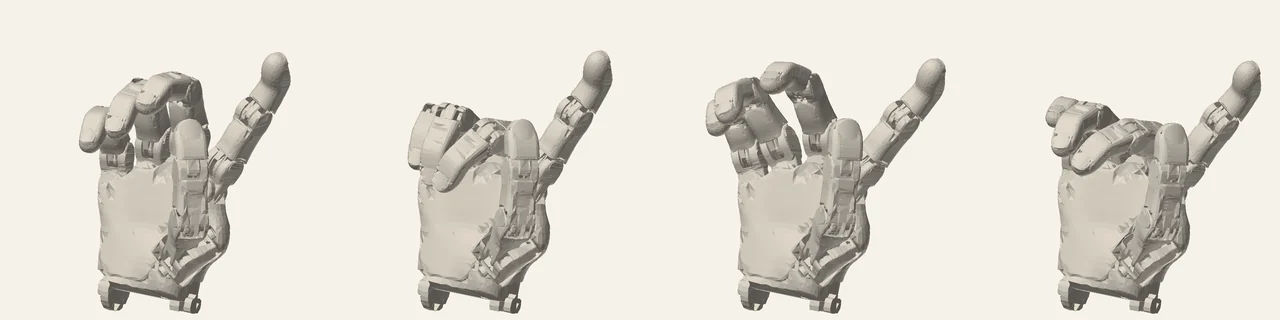
One frame clock. The render above, the ORCA replay and the keypoints in the opening figure all show loop frame k.
Without scripts each figure shows its own still; with them, one bar moves all three.
Every final we rendered14Grouped by the review's verdict, with where each one plays.
Data
| Final | Clip and time | Hands | Frames solved of 240 | Flaw the review found | Where it plays |
|---|---|---|---|---|---|
| Primary1 | |||||
| B3 | FV-B01774486.0–494.0 s | Twoclose-up with Allegro mounts | Allegro L 240 · R 240; LEAP L 240 · R 240 | LEAP hands float 24.7 mm off the arm (no LEAP mount); the left arm swings 29.5 deg per frame at k 211–214 | this stage |
| Conditional1 | |||||
| B6 | FV-B01149958.1–966.0 s | Twoclose-up with Allegro mounts | Allegro L 240 · R 240; LEAP L 240 · R 240 | a readable delivery‑app banner from k ~125; LEAP hands detached; the Allegro hands touch at k 100 (1.2 mm) | home Fig. 3, Spring onions trial |
| Honesty example1 | |||||
| S1 | FV-Z0090720.0–28.0 s | One(right) | Allegro 186; LEAP 186 | 54 frames (k 184–237) have no hand estimate and stay grey; small hands; an arm jump at k 238 after the gap | home Fig. 3, Green beans trial |
| Variants6 | |||||
| B1 | FV-B01774486.0–494.0 s | Twostandard view | Allegro L 240 · R 240; LEAP L 240 · R 240 | as B3 | Not showna standard view variant of B3, which shows the same solution |
| B2 | FV-B01774486.0–494.0 s | Twoclose-up | Allegro L 240 · R 240; LEAP L 240 · R 240 | as B3 | Not showna close‑up variant of B3, which shows the same solution |
| B4 | FV-B01149958.1–966.0 s | Twostandard view | Allegro L 240 · R 240; LEAP L 240 · R 240 | as B6 | Not showna standard view variant of B6, which shows the same solution (and the same banner) |
| B5 | FV-B01149958.1–966.0 s | Twoclose-up | Allegro L 240 · R 240; LEAP L 240 · R 240 | as B6 | Not showna close‑up variant of B6, which shows the same solution (and the same banner) |
| B7 | FV-B0047620.0–28.0 s | Twostandard view | Allegro L 240 · R 240; LEAP L 240 · R 240 | as B9 | Not showna standard view variant of B9, which shows the same solution |
| B8 | FV-B0047620.0–28.0 s | Twoclose-up | Allegro L 240 · R 240; LEAP L 240 · R 240 | as B9 | Not showna close‑up variant of B9, which shows the same solution |
| Not recommended1 | |||||
| B9 | FV-B0047620.0–28.0 s | Twoclose-up with Allegro mounts | Allegro L 240 · R 240; LEAP L 240 · R 240 | the two robot hands pass into each other (Allegro, 54 frames, up to 11.5 mm); hidden hands; a seam at the mount | home Fig. 3, Latch trial |
| Not used4 | |||||
| S2 | FV-B01774486.0–494.0 s | One(right) | Allegro 240; LEAP 240 | the knife grip barely moves | Not showna one‑hand run of the thread, which B3 shows two‑handed |
| S3 | FV-B01773256.8–264.8 s | One(right) | Allegro 239; LEAP 240 | a legible brand logo at k ~230–239; small hands; a 0.28 m jump at the loop seam | Not showna legible brand logo at k ~230–239 |
| S4 | FV-B01149958.1–966.0 s | One(right) | Allegro 240; LEAP 240 | a readable delivery‑app banner | Not showna readable delivery‑app banner; B6 shows the clip |
| S5 | FV-B0047620.0–28.0 s | One(right) | Allegro 240; LEAP 240 | the robot hands bob up to ~11 cm (a depth swing) | Not showna one‑hand run of the latch clip, which B9 shows two‑handed |
14 rows, none left outHand estimates checked on 12 recordings; retargeted on five.
A bar is one robot arm: the lit part is the frames with a robot solution.
Notes (3)
- Frames solved: our retargeting summary for each robot arm; a frame without a hand estimate stays grey and is not solved.
- Review: our audit of the robot-hand renders. Continuity limits were loosened per clip (0.03 to 0.12 m and 15 to 35 deg per frame against the published 0.02 m and 15 deg).
- Hand poses are monocular estimates; nothing here measures their accuracy. Simulated in PyBullet, no object modelled.
Every number 8
- Both hands solved in 240 of 240 frames on 4 arms.Source: our audit of the robot‑hand renders (their retargeting summaries and the sync check)
- Continuity limits of 0.1 m per frame for the hand and 30° for the arm, against the method's defaults of 0.02 m and 15°; at the defaults the left hand solves in 198 of 240 frames. Solved with per‑clip choices: wearer hints, exclusion zones and a camera fit.Source: our audit of the robot‑hand renders (their retargeting summaries and the sync check)
- Sync check on the render masters: 49.10, 48.75, 45.16 dB against a 35 dB floor. It checks frame indexing only, not how well the hand estimate is timed.Source: our audit of the robot‑hand renders (their retargeting summaries and the sync check)
- Robot grip opening against the estimated human one (correlation, Allegro / LEAP): left 0.97 / 0.98, right 0.81 / 0.91 (the right hand holds the knife).Source: our audit of the robot‑hand renders (their retargeting summaries and the sync check)
- In this clip the Allegro thumb misses its target by 37.4 mm (left) and 43.1 mm (right) on average.Source: our retargeting summary for each hand of this clip, mean over the solved frames
- ORCA replay: FV-B01774's right hand at loop frames k 0–209 (486.0–493.0 s, 30.0 frames a second), with its own estimate in 210 of 210 frames, retargeted to 16 finger joints, each frame on its own. Before the display smoothing, a joint moves a median 2.6° between frames, 16.1° at the 95th percentile and at most 79.3°.Source: the replay's data (computed at build from our HaMeR estimates, retargeted with the hand prior's retargeter)
- The loop shows frames k 0–209: 7.0 s shown for 7.007 s filmed (loop frame k = camera frame 2k; it runs 0.1% fast).Source: the layer scrubber's clock (computed at build from the render and the camera frames)
- Across all 14 of our Allegro renders, each hand's mean thumb miss lies between 31.7 and 43.3 mm.Source: the retargeting summaries of every final in stage 5's ledger (mean thumb miss per hand, over the solved frames)
06Robot video
Arms out. Robot in.
Our re-implementations of Masquerade and a contact-aware pass, on the same frames.
FV-B01774 · 486.0–494.0 sthread clip, edited footage
Edited footage
Edited footage: the arms are painted out by a model and a simulated robot is drawn in. Not robot footage.
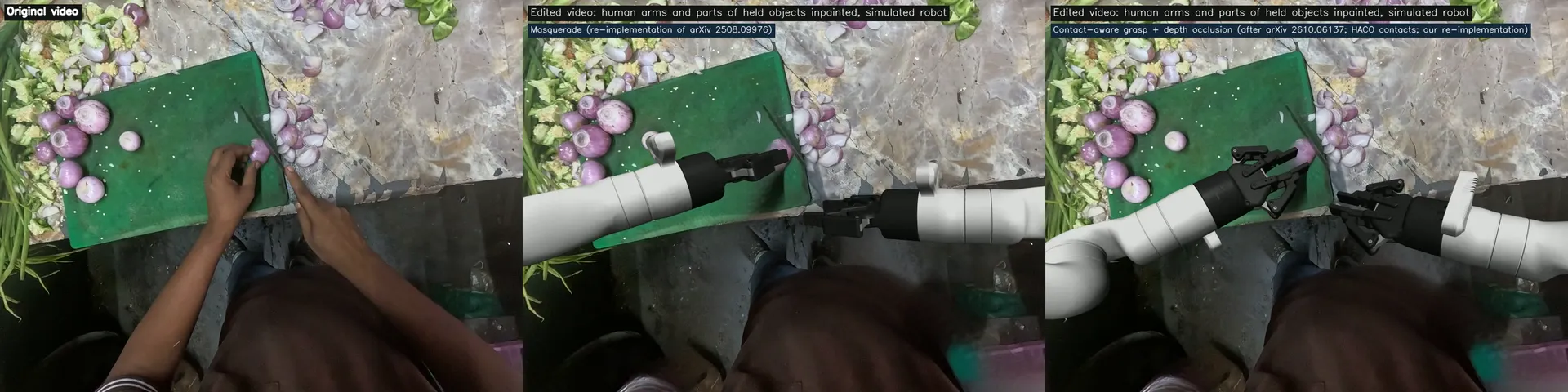
Edited footage. One three-panel file, so both sides of the divider are the same decoded frame.
Notes (4)
- The arms are painted out by a model and simulated robot arms are drawn in, each posed from the hand estimated in the same frame. No gripper visibly holds anything: held objects are partly painted out with the hands.
- Our re-implementations of published methods (Masquerade, arXiv 2508.09976; a contact-aware pass after arXiv 2610.06137, whose authors released no code). Not the authors' code or results.
- On this clip the pads sit 2.2 to 5.8 mm from another model's contact estimates, against 13.5 to 42.6 mm; those estimates are uncertain by centimetres, so this is not measured contact.
- The contact-aware depth test hides up to 27.2% of the right gripper at k 155.
The edit, in six stepsOne frame of the thread through each step of our re-implementation.
Edited footage: the arms are painted out by a model and a simulated robot is drawn in. Not robot footage.
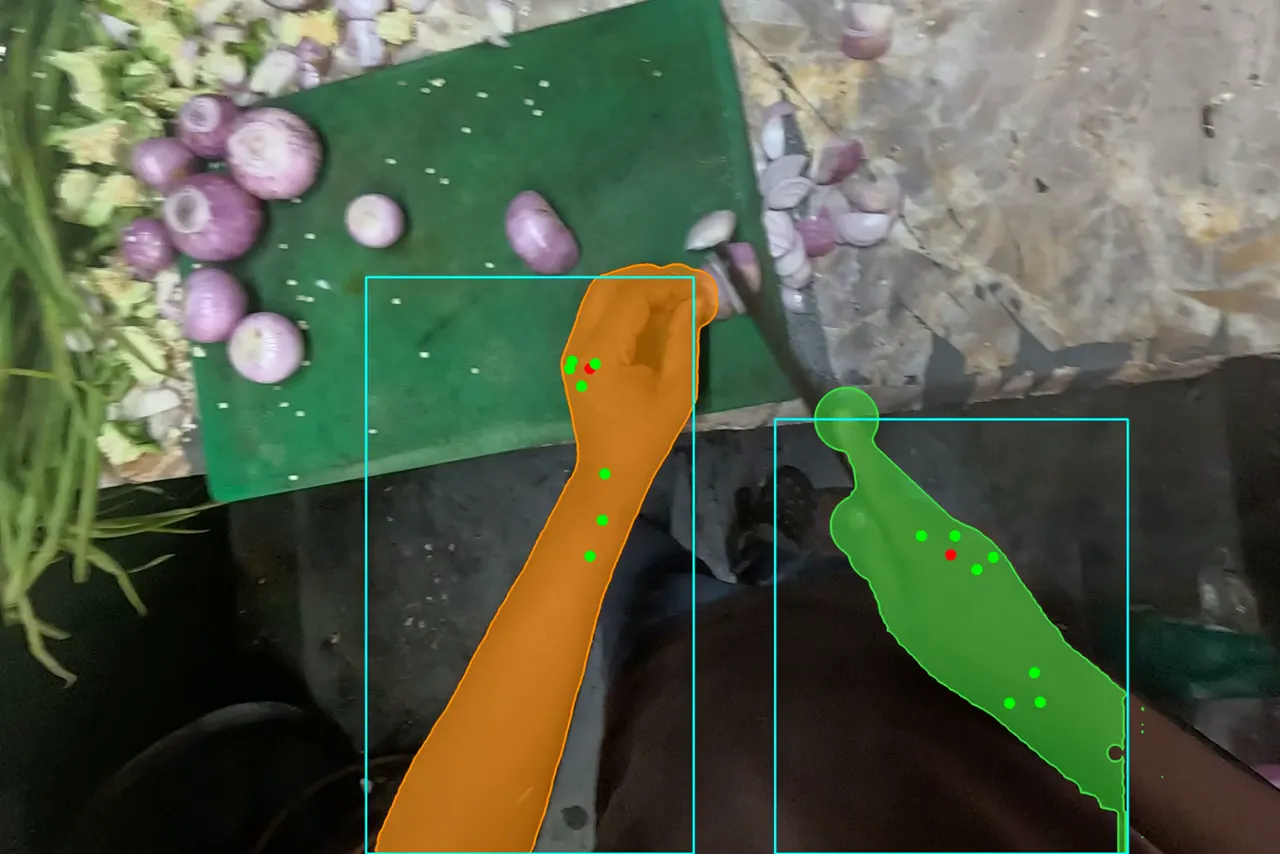
Masks A segmentation model outlines each arm in every frame (orange right, green left), with the hand estimate's keypoints. 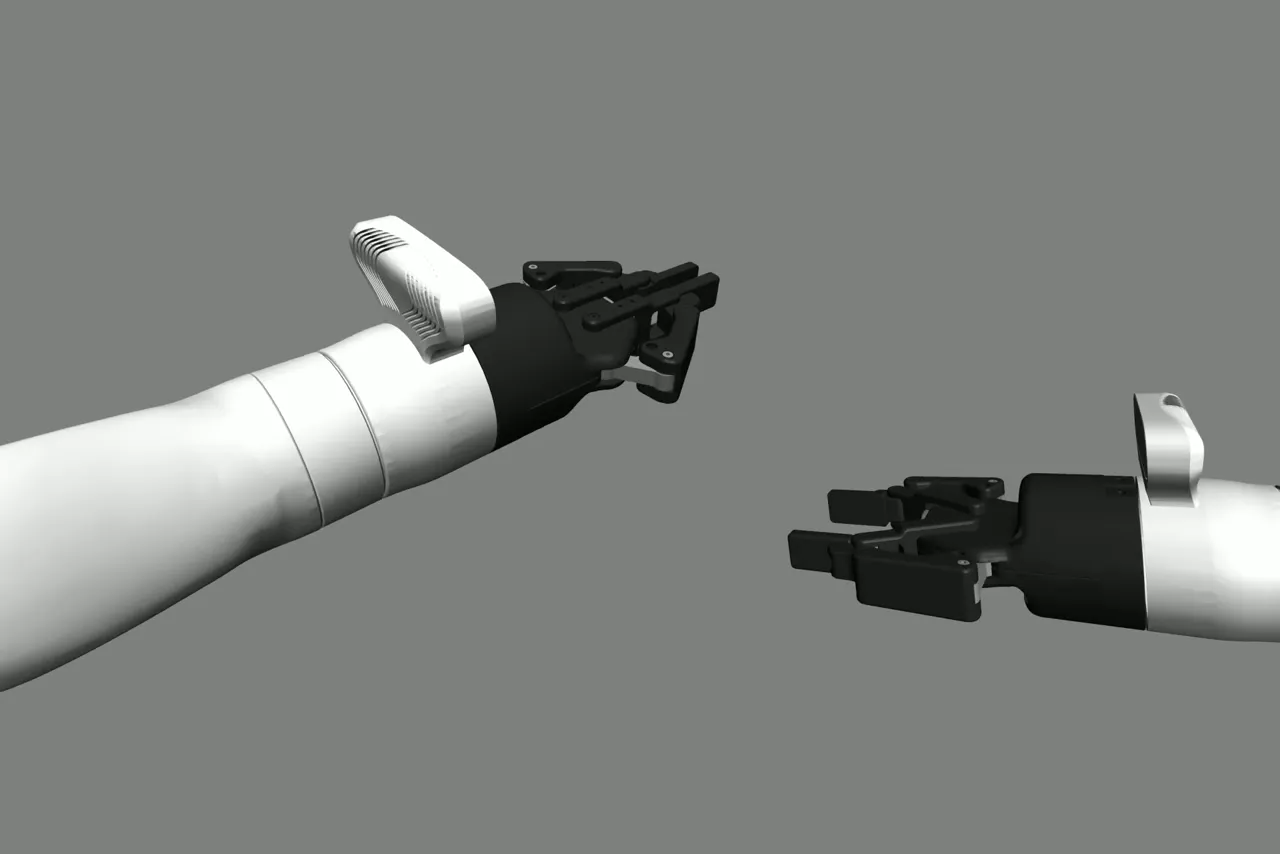
Robot Two simulated robot arms posed from the hand estimates, before they are drawn into the frame. 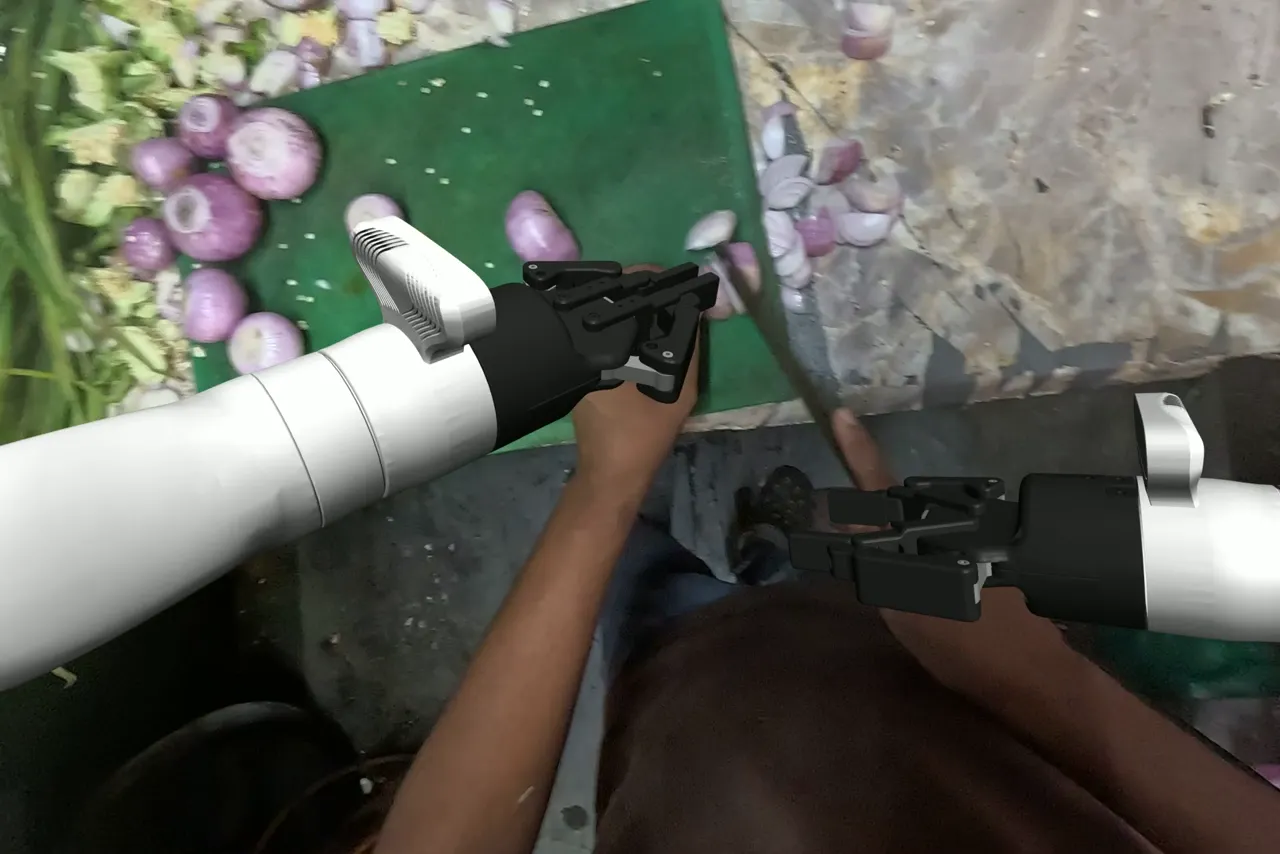
Overlay An alignment check, with the human arms still visible underneath. 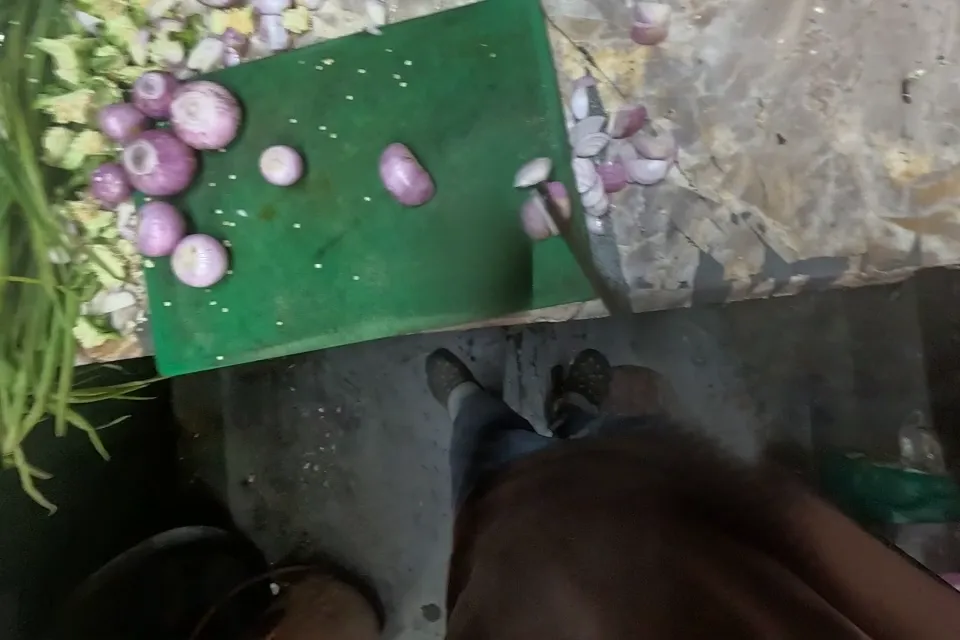
Rough paint Every masked pixel is painted over, including frames without a hand estimate. It is not an output. 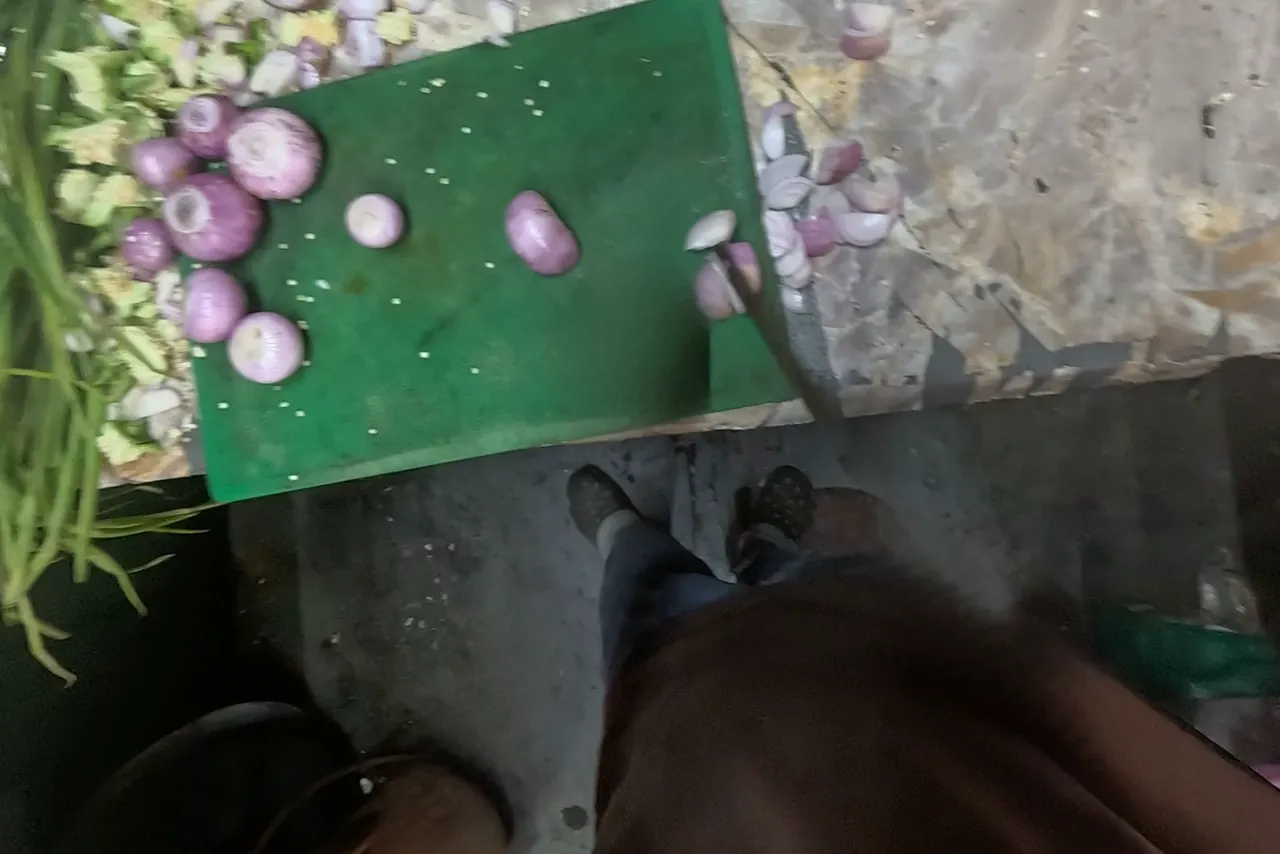
Paint out The arms painted out where they will be replaced. 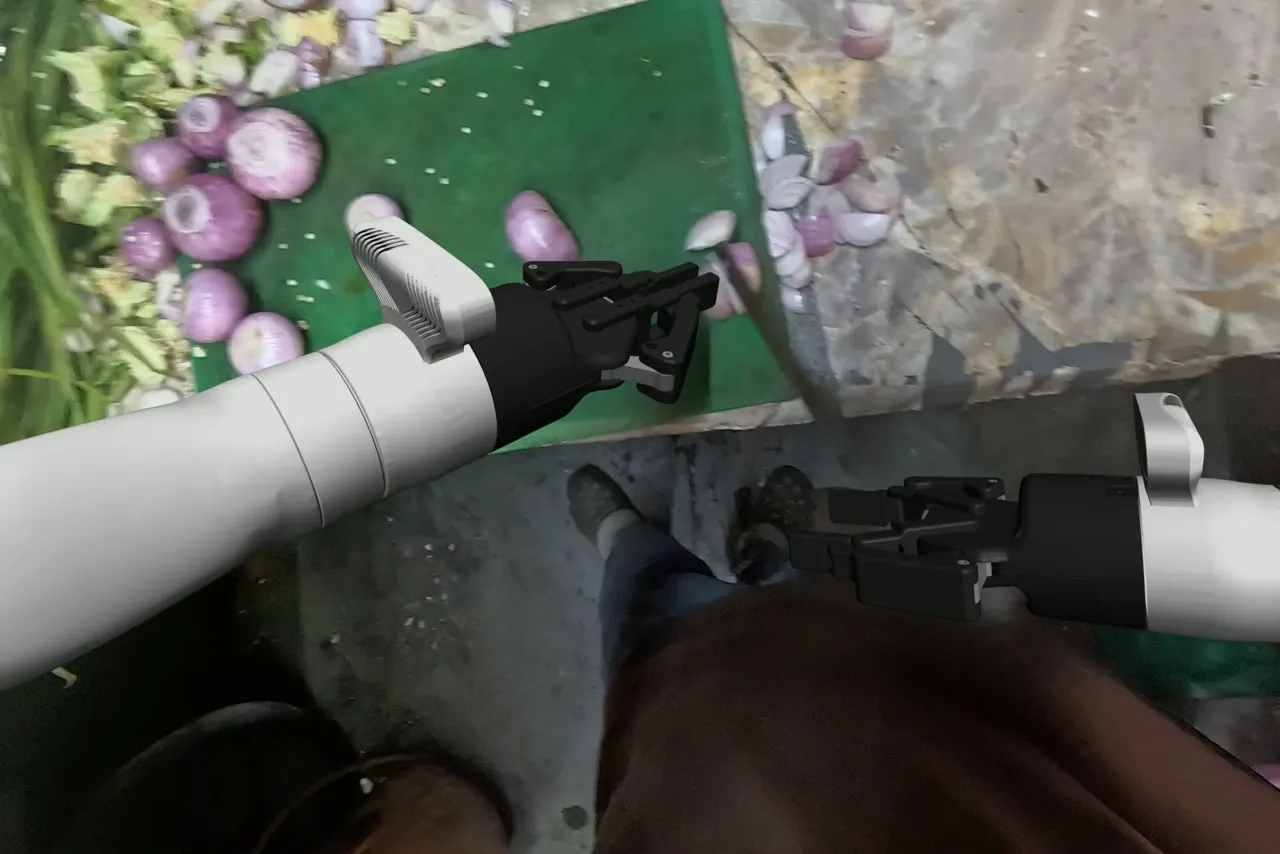
Composite The simulated robot drawn into the painted frame.
Three fixes we tried, before and afterEach pair is one frame, before and after the change.
Edited footage: the arms are painted out by a model and a simulated robot is drawn in. Not robot footage.
Paint at full size
At 342×256 the painted area smears. The same painter at 960×720 is the size we kept.
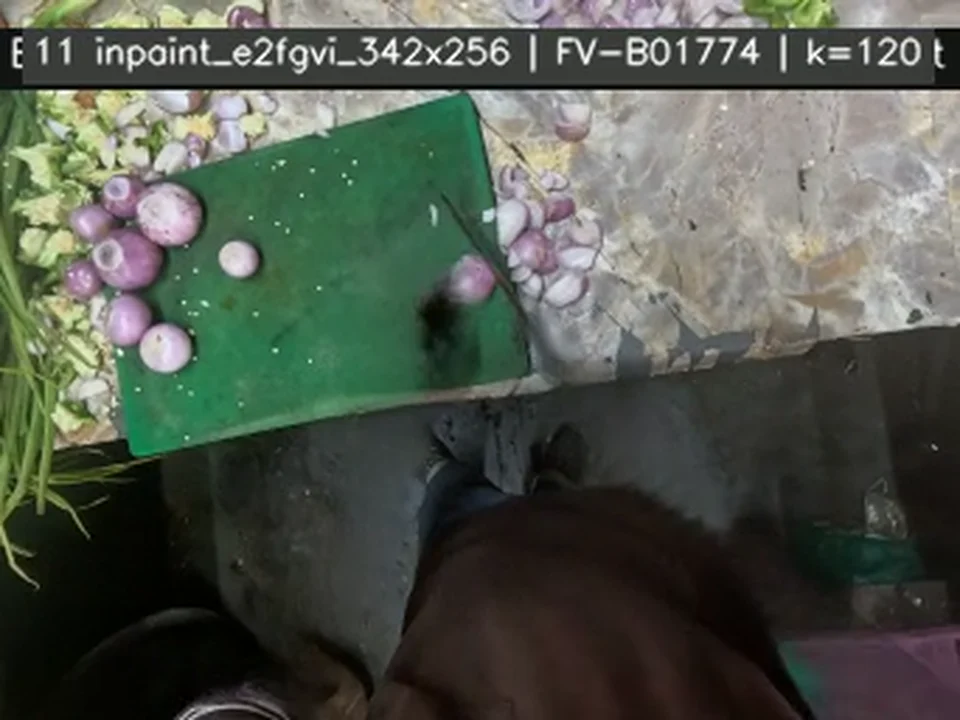
Before 342×256not kept 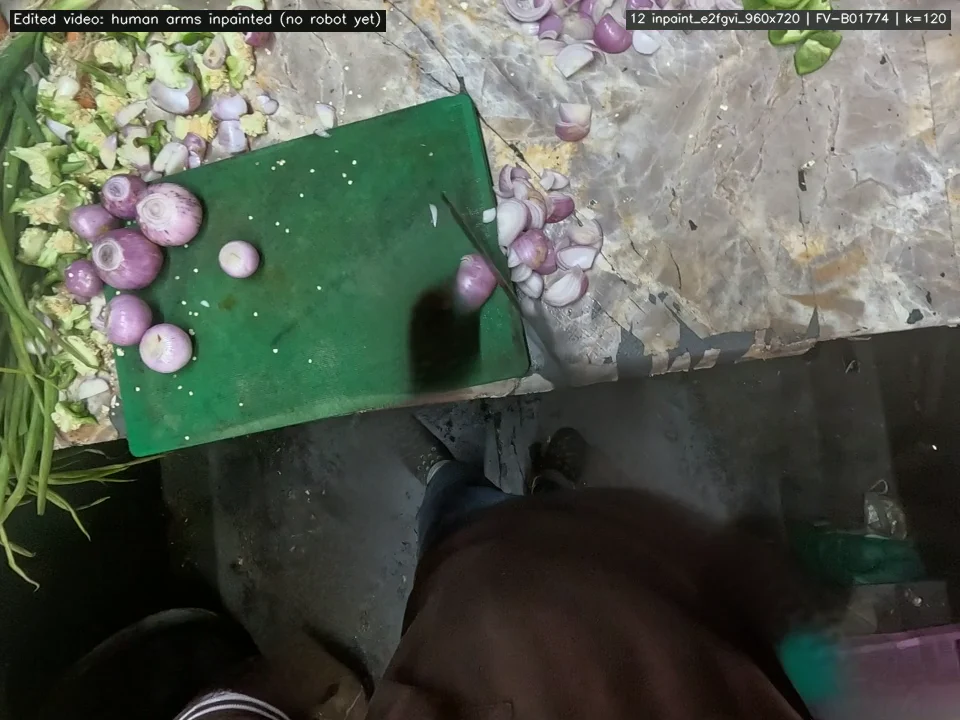
After 960×720kept Try a second painter
ProPainter in place of E2FGVI‑HQ, on the same masks: both leave a teal smear, so E2FGVI‑HQ stayed.
Before E2FGVI‑HQkept 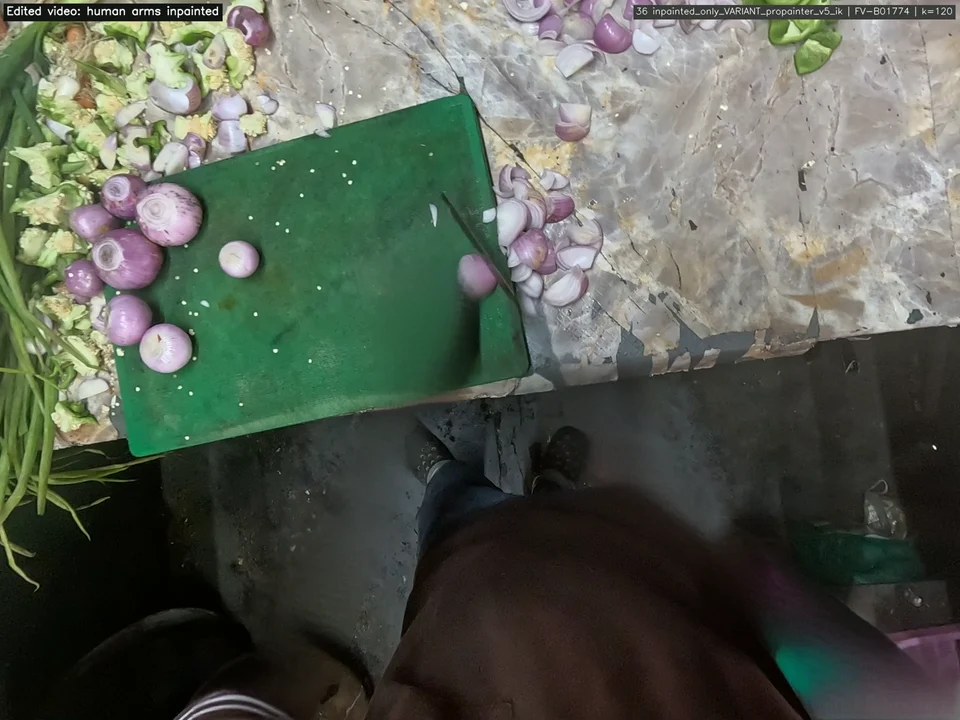
After ProPainternot kept Roll the gripper the authors' way
Our gripper roll, against the authors', which closes the gripper across the thumb-index line. We kept theirs.
Before Our rollnot kept After The authors' rollkept
Every Masquerade clip14Passing or failing the both-arms rule, with where each one plays.
Data
| Clip, workplace | Frames edited of 240 | What the QA found | Where it plays |
|---|---|---|---|
| Passes the rule7 | |||
| FV-C01442 171.8–179.8 sCarpentry | R 240 · L 240 | a smear; the contact‑aware right gripper is hidden at k 33–45 and 228–239 | home Fig. 7a, Carpentry tab |
| FV-C01720 676.5–684.5 sHVAC services | R 240 · L 240 | the grippers pass through each other in 43 frames; shown from k 46 | home Fig. 7a, HVAC tab |
| FV-B01919 416.7–424.7 sMetal | R 240 · L 240 | a 49.8 deg joint step at k 169–170; the contact forearm covers 22–24% of the frame at k 0–32 | home Fig. 7a, Metal tab |
| FV-B01174 62.7–70.7 sHVAC services | R 240 · L 240 | the grippers fuse in 46–49 frames | home Fig. 7a, Small parts tab |
| FV-B01774 486.0–494.0 sKitchen | R 240 · L 240 | the contact‑aware depth test hides up to 27.2% of the right gripper at k 155; a teal smear | this stage |
| FV-B01149 958.1–966.0 sKitchen | R 240 · L 240 | the wearer's fingers left in the painted frame at k 180 | Not showna readable delivery‑app banner |
| GX010005 879.1–887.1 sCarpentry | R 240 · L 240 | the elbow snaps between frames | Not shownreligious print on the wearer's garment in every frame |
| Fails the rule7 | |||
| FV-C01283 1140.4–1148.4 sKitchen | R 239 · L 240 | right arm unedited in 1 frame | Not shown |
| FV-C01321 285.7–293.7 sCarpentry | R 194 · L 240 | right arm unedited in 46 frames | Not shown |
| FV-B00476 20.0–28.0 sMetal | R 240 · L 221 | left arm unedited in 19 frames | Not shown |
| FV-Z00907 20.0–28.0 sKitchen | R 174 · L 213 | right arm unedited in 66 frames; left arm unedited in 27 frames | Not shown |
| FV-B01773 80.0–88.0 sKitchen | R 193 · L 217 | right arm unedited in 47 frames; left arm unedited in 23 frames | Not shown |
| FV-B01773 256.8–264.8 sKitchen | R 234 · L 225 | right arm unedited in 6 frames; left arm unedited in 15 frames | Not shown |
| FV-B01784 122.2–130.2 sKitchen | R 217 · L 222 | right arm unedited in 23 frames; left arm unedited in 18 frames | Not shown |
14 rows, none left out1,183 archive rows (renders, intermediates and encoded frame folders) from 13 recordings went into these.
7 of 14 meet the rule (both arms edited in every one of the 240 frames). A bar is one arm: the lit part is the frames where it was replaced.
Notes (3)
- Frames edited: our final edit plan for each clip, per arm, of 240; the rule is both arms edited in every one of the 240 frames.
- Our re-implementation of Masquerade (arXiv 2508.09976); no gripper holds anything, and painted pixels are generated, not footage.
- Passing clips that are not shown fail on content, not on the rule.
Every number 4
- Our re‑implementations: Masquerade (arXiv 2508.09976), and a contact‑aware pass after arXiv 2610.06137.Source: the papers, cited as the authors' methods; the code and the results here are ours
- Both arms replaced in all 240 frames of the clip, in both edited panels.Source: renders.json (the render's own length and frame rate) and our QA of this clip
- Contact‑aware pads 2.2 to 5.8 mm (median) from HACO's estimated contacts, against 13.5 to 42.6 mm for Masquerade on the same rig. Distances to another model's estimates, not measured contact.Source: our comparison of the two methods on this clip, against HACO's estimated contacts
- Occlusion is not depth‑correct: up to 27.2% of a gripper is hidden at k 155.Source: our audit of the edited‑footage renders
07Hands in common
Hands have habits.
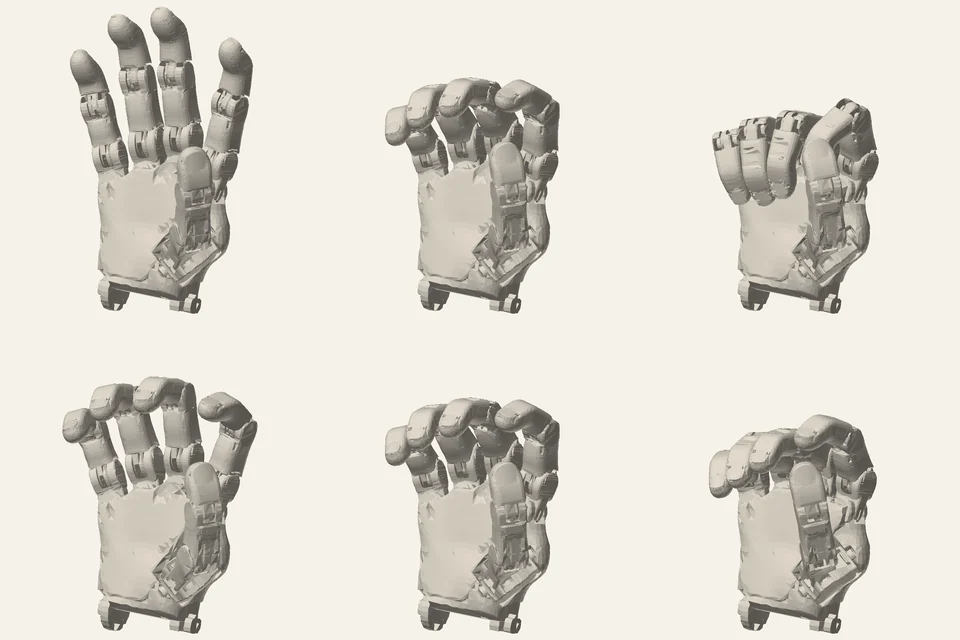
Eight of 16 directions hold 91.8% of the posture variance of 55,088 estimated poses.
Hand-posture explorer: 55,088 estimated wearer hand poses mapped onto the 16 finger joints of an ORCA v2 hand model;8 directions hold 91.8% of the posture variance.
- Kitchen
- HVAC and electrical
- Carpentry
- Welding and fabrication
More, unstable
Treat them as this basis, not as patterns.
Allegro mappingTop-2 overlap with EigenDEXplore's basis (arXiv 2610.07681v1): 0.81, where random planes reach 0.27 (95th percentile); 0.86 for our earlier retargeting. Our first direction is no closer to theirs than a plain closing motion (0.49 against 0.49).
Published bases need 3 to 10 directions for 90%; the 16-joint Allegro one needs 10.
- PC1 and PC2, stable. They keep their identity under the official ORCA retargeting objective (cosine 0.95 and 0.87).
- PC3 and PC4, provisional. Under that objective they swap and mix (cosine 0.14 and 0.33), though the top-4 subspace largely holds (overlap 0.86).
- PC5 to PC8, unstable. They change even between random halves of our own data.
Not shown: a training gain. The prior has not been used to train a robot; in our only pipeline check, random directions learned faster at that budget. The poses are monocular estimates, and the hand detector and wearer rule behind them have not been scored against labelled frames.
Every direction, every trade
The first direction, closing the whole hand, holds 42.9% of the variance; the top 3 hold 69.1%. Each trade alone needs 7 or 8 directions, and the pooled top 8 capture 89.4% to 92.6% of each trade's variance.
| Direction | Share | Cumulative | σ (rad) |
|---|---|---|---|
| PC1 | 42.9% | 42.9% | 0.91 |
| PC2 | 16.8% | 59.7% | 0.57 |
| PC3 | 9.4% | 69.1% | 0.43 |
| PC4 | 7.0% | 76.1% | 0.37 |
| PC5 | 5.2% | 81.2% | 0.32 |
| PC6 | 4.5% | 85.8% | 0.30 |
| PC7 | 3.2% | 88.9% | 0.25 |
| PC8 | 2.9% | 91.8% | 0.23 |
| Trade | Directions for 90% | Pooled top 8 capture | PC1 share |
|---|---|---|---|
| Kitchen | 7 | 92.6% | 43.8% |
| HVAC and electrical | 8 | 91.9% | 46.5% |
| Carpentry | 7 | 92.0% | 47.9% |
| Welding and fabrication | 8 | 89.4% | 33.3% |
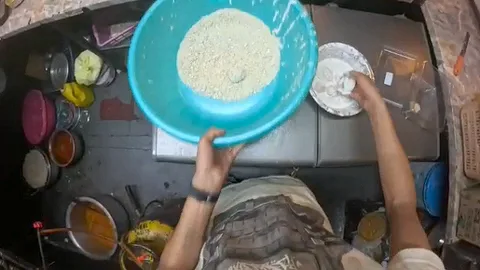
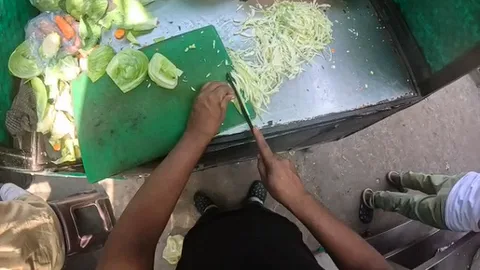
Real hands: the poses nearest the model's posture, each from a different recording, cropped to the hand's box from a frame of the camera's low‑resolution proxy, with HaMeR's estimated 21‑keypoint skeleton. Left hands were mirrored onto the right hand for the fit, not in the crops.
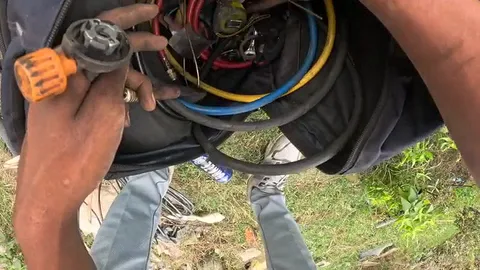
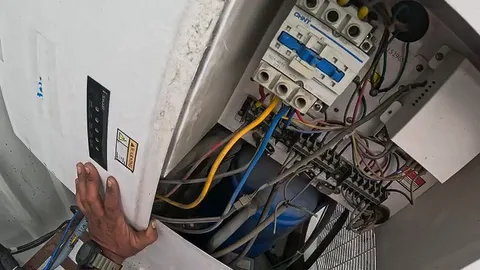
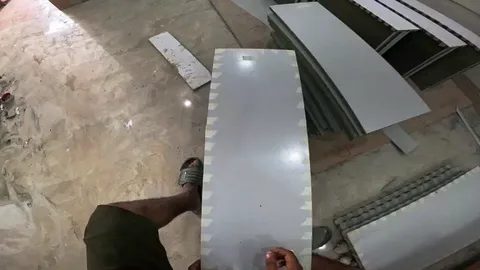
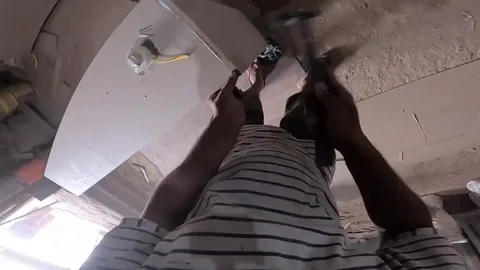
Every number 4
- 55,088 wearer hand poses; 8 of 16 directions hold 91.8% of the posture variance; the first holds 42.9%.Source: the figure's data, generated from our hand‑prior fit report
- About 2 hours of kitchen, HVAC, carpentry and welding work, estimated at 6 frames a second; each trade alone needs 7 or 8 directions, and the pooled top 8 capture 89.4% to 92.6% of each trade's variance.Source: our hand‑prior report
- Published bases need 3 to 10 directions for 90%; the 16-joint Allegro one needs 10.Source: published hand‑posture bases, as compared in our hand‑prior report
- On an Allegro mapping, top-2 overlap with EigenDEXplore's basis 0.81, where random planes reach 0.27 (95th percentile).Source: our hand‑prior report
08Training
Next frame. Next move.
World models predict the next frames; policies choose the next action.
FV-Z00907 · 20.0–28.0 sanother clip, data: head or scene
HERO10 Black Wide, stabilisation off, 14.98 frames/s steps
Across the 119 steps the head's rotation predicts a median 40% of the picture's change.
| Time (s) | Total change | Head rotation | Residual | Head share |
|---|---|---|---|---|
| 20.01 | 22.9 | 7.0 | 15.9 | 31% |
| 20.07 | 26.1 | 11.5 | 14.6 | 44% |
| 20.14 | 27.5 | 14.9 | 12.6 | 54% |
| 20.21 | 24.4 | 14.7 | 9.7 | 60% |
| 20.27 | 15.1 | 4.2 | 10.9 | 28% |
| 20.34 | 20.1 | 5.1 | 15.1 | 25% |
| 20.41 | 24.2 | 5.8 | 18.4 | 24% |
| 20.47 | 23.9 | 3.3 | 20.7 | 14% |
| 20.54 | 25.4 | 3.9 | 21.6 | 15% |
| 20.61 | 20.4 | 0.7 | 19.7 | 4% |
| 20.67 | 19.0 | 3.5 | 15.4 | 19% |
| 20.74 | 16.9 | 3.5 | 13.5 | 21% |
| 20.81 | 16.8 | 5.7 | 11.1 | 34% |
| 20.87 | 9.2 | 0.0 | 9.8 | 0% |
| 20.94 | 10.5 | 0.0 | 10.6 | 0% |
| 21.01 | 13.7 | 3.5 | 10.3 | 25% |
| 21.07 | 13.3 | 4.2 | 9.1 | 32% |
| 21.14 | 15.8 | 2.2 | 13.6 | 14% |
| 21.21 | 19.8 | 2.8 | 17.0 | 14% |
| 21.27 | 15.4 | 0.0 | 18.1 | 0% |
| 21.34 | 10.3 | 0.0 | 17.1 | 0% |
| 21.41 | 11.6 | 0.0 | 16.1 | 0% |
| 21.47 | 13.4 | 0.0 | 17.4 | 0% |
| 21.54 | 16.4 | 0.0 | 18.2 | 0% |
| 21.61 | 20.0 | 4.0 | 16.0 | 20% |
| 21.68 | 25.6 | 12.2 | 13.5 | 48% |
| 21.74 | 27.1 | 14.5 | 12.7 | 53% |
| 21.81 | 27.3 | 15.4 | 11.8 | 56% |
| 21.88 | 22.5 | 14.4 | 8.1 | 64% |
| 21.94 | 24.1 | 14.0 | 10.2 | 58% |
| 22.01 | 32.0 | 17.3 | 14.7 | 54% |
| 22.07 | 35.0 | 18.5 | 16.5 | 53% |
| 22.14 | 30.9 | 16.0 | 14.9 | 52% |
| 22.21 | 21.2 | 8.0 | 13.3 | 38% |
| 22.27 | 36.0 | 16.8 | 19.2 | 47% |
| 22.34 | 32.8 | 16.3 | 16.6 | 50% |
| 22.41 | 24.8 | 14.2 | 10.6 | 57% |
| 22.48 | 23.7 | 9.1 | 14.6 | 39% |
| 22.54 | 32.3 | 15.2 | 17.1 | 47% |
| 22.61 | 23.9 | 6.6 | 17.3 | 28% |
| 22.68 | 22.1 | 2.7 | 19.4 | 12% |
| 22.74 | 23.5 | 2.4 | 21.1 | 10% |
| 22.81 | 29.0 | 7.4 | 21.6 | 25% |
| 22.88 | 23.0 | 1.0 | 22.0 | 4% |
| 22.94 | 17.0 | 0.0 | 20.7 | 0% |
| 23.01 | 20.9 | 2.4 | 18.5 | 11% |
| 23.08 | 23.9 | 8.5 | 15.3 | 36% |
| 23.14 | 20.6 | 9.4 | 11.1 | 46% |
| 23.21 | 15.1 | 5.9 | 9.2 | 39% |
| 23.28 | 13.1 | 1.8 | 11.3 | 14% |
| 23.34 | 17.6 | 4.2 | 13.5 | 24% |
| 23.41 | 16.8 | 1.9 | 14.9 | 11% |
| 23.48 | 30.4 | 13.1 | 17.3 | 43% |
| 23.54 | 30.3 | 13.2 | 17.0 | 44% |
| 23.61 | 29.2 | 13.6 | 15.7 | 46% |
| 23.68 | 24.5 | 10.5 | 14.0 | 43% |
| 23.74 | 14.4 | 3.2 | 11.1 | 23% |
| 23.81 | 15.9 | 7.7 | 8.2 | 49% |
| 23.88 | 12.8 | 5.8 | 7.0 | 45% |
| 23.94 | 12.6 | 6.3 | 6.3 | 50% |
| 24.01 | 9.2 | 3.5 | 5.7 | 38% |
| 24.08 | 9.7 | 4.1 | 5.7 | 42% |
| 24.14 | 10.6 | 4.2 | 6.4 | 40% |
| 24.21 | 11.4 | 4.6 | 6.8 | 41% |
| 24.28 | 12.9 | 5.7 | 7.2 | 44% |
| 24.34 | 14.1 | 7.4 | 6.8 | 52% |
| 24.41 | 12.5 | 6.0 | 6.5 | 48% |
| 24.48 | 7.7 | 2.4 | 5.3 | 31% |
| 24.54 | 11.4 | 5.3 | 6.1 | 47% |
| 24.61 | 11.7 | 5.9 | 5.8 | 50% |
| 24.68 | 8.0 | 2.7 | 5.3 | 34% |
| 24.74 | 6.7 | 1.5 | 5.2 | 23% |
| 24.81 | 8.5 | 3.0 | 5.4 | 36% |
| 24.88 | 11.1 | 5.3 | 5.8 | 47% |
| 24.95 | 8.7 | 3.5 | 5.2 | 40% |
| 25.01 | 7.4 | 1.1 | 6.3 | 15% |
| 25.08 | 11.3 | 4.0 | 7.3 | 35% |
| 25.14 | 9.8 | 2.3 | 7.5 | 23% |
| 25.21 | 11.6 | 3.9 | 7.6 | 34% |
| 25.28 | 10.6 | 3.4 | 7.2 | 32% |
| 25.34 | 15.4 | 8.4 | 6.9 | 55% |
| 25.41 | 16.9 | 9.1 | 7.7 | 54% |
| 25.48 | 23.0 | 13.0 | 9.9 | 57% |
| 25.55 | 26.3 | 15.2 | 11.1 | 58% |
| 25.61 | 15.9 | 4.8 | 11.1 | 30% |
| 25.68 | 32.4 | 18.3 | 14.1 | 56% |
| 25.75 | 32.2 | 19.0 | 13.2 | 59% |
| 25.81 | 25.2 | 13.0 | 12.2 | 52% |
| 25.88 | 32.9 | 18.0 | 14.9 | 55% |
| 25.95 | 29.9 | 15.2 | 14.7 | 51% |
| 26.01 | 24.7 | 13.1 | 11.6 | 53% |
| 26.08 | 17.0 | 7.0 | 10.0 | 41% |
| 26.15 | 25.1 | 12.5 | 12.6 | 50% |
| 26.21 | 20.5 | 8.1 | 12.4 | 39% |
| 26.28 | 22.9 | 10.5 | 12.4 | 46% |
| 26.35 | 25.0 | 13.9 | 11.1 | 56% |
| 26.41 | 24.6 | 14.0 | 10.6 | 57% |
| 26.48 | 26.3 | 15.2 | 11.2 | 58% |
| 26.55 | 25.4 | 12.8 | 12.6 | 51% |
| 26.61 | 22.1 | 9.9 | 12.2 | 45% |
| 26.68 | 22.6 | 11.0 | 11.6 | 49% |
| 26.75 | 22.3 | 11.1 | 11.2 | 50% |
| 26.81 | 21.9 | 9.7 | 12.2 | 44% |
| 26.88 | 18.8 | 9.0 | 9.8 | 48% |
| 26.95 | 13.2 | 6.3 | 7.0 | 47% |
| 27.01 | 5.8 | 0.5 | 5.3 | 8% |
| 27.08 | 4.1 | 0.0 | 4.9 | 0% |
| 27.15 | 22.4 | 14.1 | 8.4 | 63% |
| 27.21 | 20.2 | 10.7 | 9.5 | 53% |
| 27.28 | 18.6 | 9.7 | 8.9 | 52% |
| 27.35 | 22.2 | 11.6 | 10.6 | 52% |
| 27.41 | 18.4 | 9.5 | 8.8 | 52% |
| 27.48 | 15.9 | 5.1 | 10.7 | 32% |
| 27.55 | 17.2 | 2.8 | 14.4 | 16% |
| 27.61 | 16.8 | 1.7 | 15.0 | 10% |
| 27.68 | 24.0 | 6.9 | 17.1 | 29% |
| 27.75 | 28.5 | 7.8 | 20.8 | 27% |
| 27.81 | 30.5 | 6.0 | 24.5 | 20% |
| 27.88 | 24.6 | 2.0 | 22.6 | 8% |
FV-B00476 · 36.0–44.0 sanother clip, footage: what happens next, in metal work
Reviewer's reading, not a label: Both hands work a small bolt on the gate latch, then the right hand takes a tool.
Context
 37.0 s
 38.0 s
 39.0 s
 39.5 s
What actually happened
 40.0 s
 40.5 s
 41.5 s
 42.5 s
Published work, the authors' results4What labs report from human video. None of it is our result.
- DreamDojo arXiv 2602.06949, ICML 2026: pretraining a robot world model on about 44,000 h of egocentric human video improved its prediction of robot video, mostly from adding the stage at all.
- EgoVerse arXiv 2604.07607: co-training policies on human video, with hand pose as the action.
- Human2Sim2Robot arXiv 2504.12609, CoRL 2025: retargeting human hand motion onto a robot hand, then refining it in simulation.
- Masquerade arXiv 2508.09976: editing the human arms in video into a robot's.
Every number 2
- FV-Z00907: a rotation‑only model gives the head a median 40.3% of each step's picture change (38.3% pooled over 119 steps).Source: the head‑or‑scene data (computed at build from the clip's frames, its gyro and the provisional lens calibration)
- DreamDojo: about 44,000 h of egocentric human video in pretraining.Source: DreamDojo, arXiv 2602.06949, ICML 2026 (the authors' result)
09What a lab receives
Four files. Then round two.
One clip's delivery, unboxed.
FV-B01774.MP4
59.94 fps
picture, sound, motion track
The camera's own file.
FV-B01774_imu
.csv head speed1,613 samples
486.0–494.0 s
Head motion, on the video clock.
FV-B01774/
Also as LeRobot v3 · RLDS · HDF5 · MCAP
What each file holds
.MP4 The camera original
- File
- The camera's own file: picture, sound, and the camera's metadata and motion track.
- Worn
- A head- or chest-mounted action camera, worn by the worker on their own shift.
- This clip
- 59.94 fps, Linear lens.
- On this site
- Camera modes of the clips here: 1920×1080 at 29.97 fps, 50 fps or 59.94 fps; 2704×2028 at 50 fps; 2704×1520 at 50 fps, 59.94 fps or 100 fps; 3840×2160 at 50 fps; 5312×2988 at 59.94 fps.
_imu.csv Columns and units
- timestamp_us
- Integer microseconds on the video's own clock. The first video frame is 0.
- ax, ay, az
- Accelerometer, m/s², gravity included: about 9.8 on one axis at rest.
- gx, gy, gz
- Gyroscope, rad/s.
_labels.json Codes and segments
- Codes
- ENV.C.SS, frozen: 10.1.01 is task 01 in task group 1 of workplace 10. The files call ENV environment_id.
- Segments
- In order, each with its code, name, start_us and end_us on the clip's own clock.
- Taxonomy
- 354 tasks that never change, public at /taxonomy.json and /taxonomy.csv.
- Narration
- In some workplaces the worker describes each action aloud, on the clip's own audio.
- Mistakes
- Drops, re-grips and do-overs are labelled as such. Long takes, not highlights.
_meta.json One record per clip
- Ids
- Sites and workers appear only as pseudonymous ids.
- Keys
clip_iddevicemountsite_idcollector_idcountryenvironment_idcaptured_atduration_usresolutionfpsfovimuhands_in_frame_pctpeople_in_clipincidental_individualsconsent- Consent
- Workers consent to capture and to machine-learning training on their footage. Anyone regularly in shot signs a consent form before capture begins.
Tell us where it slips.
- We deliver: the four files of every clip, as above.
- You test: you measure the change on your own tests.
- You tell us where your world model or robot slips: the task, the tool, the scene or the motion it gets wrong.
- We brief: the next round changes what, where, how and how much we film. If another round is unlikely to help, we say so.
- We film: real manual work, first person, on real shifts, with the camera's own motion sensor on the video clock. That delivery is round two.
- The library is round zero.
Only footage an independent expert confirms meets your criteria is billed.
Request a roundEvery number 3
- 4 files per clip, 3 without IMU.Source: the delivery layout (the free sample's folder holds the same four files)
- FV-B01774 was filmed at 59.94 frames a second: 480 frames in 486.0–494.0 s.Source: the layer scrubber's clock (computed at build from the render and the camera frames)
- The _imu.csv card draws all 1,613 gyro samples of 486.0–494.0 s as head speed, the norm of the three gyro axes.Source: the head‑motion data (computed at build from the camera's GPMF gyro track, extracted by our pipeline)
Credit where it's due.
The models, code, meshes and libraries behind the renders and figures here and on the home page, each under its licence.
Hand estimates and the hand‑posture figure (stages 3, 5 and 7)
- HaMeR (MIT (code); licensed by the owner): estimates the 21 hand keypoints frame by frame (frames without an estimate are listed), drawn as skeletons and driving every robot render.
- MANO hand model (licensed by the owner): the hand model inside HaMeR's estimates; never drawn on this site.
- WiLoR (detector weights CC BY‑NC‑ND; licensed by the owner): its hand detector finds the hands behind the hand‑posture figure (stage 7).
- Ultralytics (AGPL‑3.0): runs that detector, offline.
- MediaPipe (Apache‑2.0): hand detection in the robot‑render pipeline.
- ORCA v2 hand description (orcahand_description) (MIT): the 16‑joint hand model in stages 5 and 7. Copyright (c) 2025 ORCA. "ORCA Hand by ORCA Dexterity, Inc.", CC BY 4.0, cited to IROS 2025. ORCA is a trademark of ORCA Dexterity, Inc.; its use here names the hand model only and is not an endorsement.
- orca_core and orca_retargeter (MIT): map the estimated hand poses onto the ORCA v2 joints.
- three.js (MIT): draws the stage 5 hand replay and the stage 7 hand model and posture cloud.
Simulated robot hands (the opening figure and stage 5)
- Human2Sim2Robot (MIT): the authors' retargeting code, used with four documented line changes.
- LEAP_Hand_Sim (MIT): the LEAP hand model.
- cuRobo (licensed by the owner; meshes BSD‑2‑Clause): solves the robot arms; its Allegro and iiwa meshes.
- PyBullet (zlib): renders the simulated hands and arms.
Edited footage (the opening figure and stage 6)
- Masquerade code base (Phantom) (MIT): the starting point of our re‑implementation. Copyright (c) 2025 Stanford Interactive Perception and Robot Learning Lab.
- SAM 2 (Apache‑2.0): outlines the arms and held objects in every frame.
- E2FGVI‑HQ (licensed by the owner): paints the arms out.
- ProPainter (licensed by the owner): the alternative painter we compared.
- HACO (licensed by the owner; its checkpoint is CC BY‑NC‑SA 4.0 (share‑alike)): the contact estimates the contact‑aware pass aims at.
- MoGe‑2 (MIT): estimated depth for the contact‑aware pass.
- robosuite models of the Kinova Gen3 arm and Robotiq 2F‑85 gripper (MIT): the simulated arm and gripper drawn in.
- MuJoCo (Apache‑2.0): the physics engine under those robosuite models.
Robot and hand models in the home page figures (Fig. 3 and Fig. 4)
- KUKA iiwa 14 and Allegro hand meshes (from cuRobo) (meshes BSD‑2‑Clause, from cuRobo (licensed by the owner)): the simulated arm and hand in the 3D replay of home Fig. 3. Copyright (c) 2016‑2019 Salvatore Virga, Marco Esposito (Technische Universität München); Copyright (c) 2015 Robert Krug, Todor Stoyanov (AASS Research Center, Örebro University); Copyright (c) 2016 SimLab. All rights reserved. Redistributed under the BSD 2‑Clause License, which the copyright holders and contributors provide "as is", without any express or implied warranty.
- LEAP Hand (from LEAP_Hand_Sim) (MIT): the second simulated robot hand in home Fig. 3. Copyright 2023 Ananye Agarwal.
- ORCA v2 hand (from orcahand_description) (MIT): the ORCA hand option in home Fig. 3 and the 16‑joint hand in home Fig. 4 and stage 7. Copyright (c) 2025 ORCA. ORCA is a trademark of ORCA Dexterity, Inc., which does not endorse this site.
- Sharpa HA4 left hand (meshes from github.com/tylerlum/simtoolreal @ 313d5ae) (MIT): the left Sharpa HA4 hand beside our ORCA hand in home Fig. 4, beat 6, converted to a web mesh. Copyright (c) 2026 Tyler Lum. The package's own package.xml says BSD; the repository licence is MIT. No official Sharpa model was used, and Sharpa does not endorse this site.
- Sharpa and Allegro bases: EigenDEXplore (hgupt3/eigendexplore @ 5d57180) (MIT): the published posture directions that drive the Sharpa hand in home Fig. 4, beat 6, and the Allegro basis stage 7 compares against (the authors' results, shown as published). Copyright (c) 2026 Action‑Bench contributors.
Measured depth: the door model, the simulation and the figures (/depth)
- FoundationStereo (licensed by the owner): the stereo matcher: for each pixel it finds the shift between the two cameras' pictures; depth follows from that shift.
- COLMAP (BSD): the rig's calibration, fitted to its own footage.
- MediaPipe (Apache‑2.0): marks the hand joints in the left picture; each joint is placed at the stereo depth of the skin under it. Its own hand model gives the wrist chart's one‑camera line.
- SAM 2 (Apache‑2.0): outlines the hands, the forearms and the door leaf in the frames that are measured.
- PP‑OCRv3 text detector (Apache‑2.0): finds printed paper in the camera's pictures so that it can be blurred.
- three.js (MIT): draws the measured depth points of the lock clip.
- MuJoCo (Apache‑2.0): the physics simulator: the door model, and the episodes run again with every contact recorded (the film and the contact shares).
- MuJoCo Warp (with NVIDIA Warp) (Apache‑2.0): the GPU version of the simulator that trained the hand and ran the test episodes of each recipe.
- PyTorch (BSD‑3‑Clause): trains the simulated hand.
- ORCA v2 hand model (orca_sim and orcahand_description) (orcahand_description MIT; orca_sim licensed by the owner): the simulated hand at the door's lever, on a floating wrist. Copyright (c) 2025 ORCA. "ORCA Hand by ORCA Dexterity, Inc.", CC BY 4.0, cited to IROS 2025. ORCA is a trademark of ORCA Dexterity, Inc.; its use here names the hand model only and is not an endorsement.
- Blender (Cycles) (GPL): a tool: it renders the door still and the simulation film from the model's geometry and the recorded simulator states, one state a frame.
Related work
- EigenDEXplore (arXiv 2610.07681v1, preprint): related work: its published Allegro basis is what stage 7 compares against, using its code (MIT) for the Allegro mapping. Cited as the authors' result; they have no part in this site.
No author or maker, including ORCA Dexterity, Sharpa, KUKA, Wonik Robotics (Allegro), Kinova and Robotiq, made, reviewed or endorses these renders or this site.